
My first PostgreSQL jsonb_array_elements query lost two of five orders: the empty and NULL arrays. The job itself is simple. jsonb_array_elements('["Ohio","Texas"]') returns one jsonb row per element.
The fix is LEFT JOIN LATERAL ... ON true. Also, the plain version returns "Ohio" with quotes; the _text version returns Ohio.
Six examples follow, from a bare call to joins, filters and the object error. Tested on PostgreSQL 18.6 for Windows, with psql in VS Code.
PostgreSQL jsonb_array_elements Function Syntax
Here is the syntax:
jsonb_array_elements ( jsonb ) → setof jsonb
jsonb_array_elements_text ( jsonb ) → setof text
json_array_elements ( json ) → setof json
json_array_elements_text ( json ) → setof text
The argument is a JSON array; only its top level expands. Match the pair to your column, as my PostgreSQL JSON vs JSONB comparison explains.
Return value: rows in a column named value. NULL input returns zero rows.
Availability: the json pair since PostgreSQL 9.3, the jsonb pair since 9.4.
When to Use the jsonb_array_elements Function in PostgreSQL
Use jsonb_array_elements when you need to:
- turn API line items into report rows
- sum values stored inside a JSON array
- find rows where any element matches
- sort by a value inside JSON, as in ORDER BY on a JSON field
Run this once. Every example uses these five US orders:
DROP TABLE IF EXISTS orders;
CREATE TABLE orders (
  id       int PRIMARY KEY,
  customer text,
  items    jsonb
);
INSERT INTO orders VALUES
 (1001, 'Hannah Brooks',
  '[{"sku":"MUG-12","qty":2,"price":14.50},
    {"sku":"TEE-M","qty":1,"price":22.00}]'),
 (1002, 'Tyler Reed',     '[{"sku":"CAP-01","qty":3,"price":18.00}]'),
 (1003, 'Grace Miller',   '[]'),
 (1004, 'Marcus Bennett', NULL),
 (1005, 'Olivia Carter',  '[{"sku":"MUG-12","qty":4,"price":14.50}]');
Example 1: jsonb_array_elements vs jsonb_array_elements_text
Let’s start small. I want both versions side by side:
SELECT *
FROM ROWS FROM (
  jsonb_array_elements('["Ohio", "Texas"]'),
  jsonb_array_elements_text('["Ohio", "Texas"]')
) AS t(as_jsonb, as_text);
Output:
 as_jsonb | as_text
----------+---------
 "Ohio"   | Ohio
 "Texas"  | Texas
(2 rows)
For Ohio, this returns "Ohio" (jsonb) and Ohio (text). Compare plain strings with _text.
Example 2: Expand a JSON Array to Rows in PostgreSQL (LATERAL Join)
Each order has an items array. The goal is one row per item:
SELECT o.id, i->>'sku' AS sku,
       (i->>'qty')::int AS qty
FROM orders o
CROSS JOIN LATERAL jsonb_array_elements(o.items) AS i
ORDER BY o.id;
Output:
  id  |  sku   | qty
------+--------+-----
 1001 | MUG-12 |   2
 1001 | TEE-M  |   1
 1002 | CAP-01 |   3
 1005 | MUG-12 |   4
(4 rows)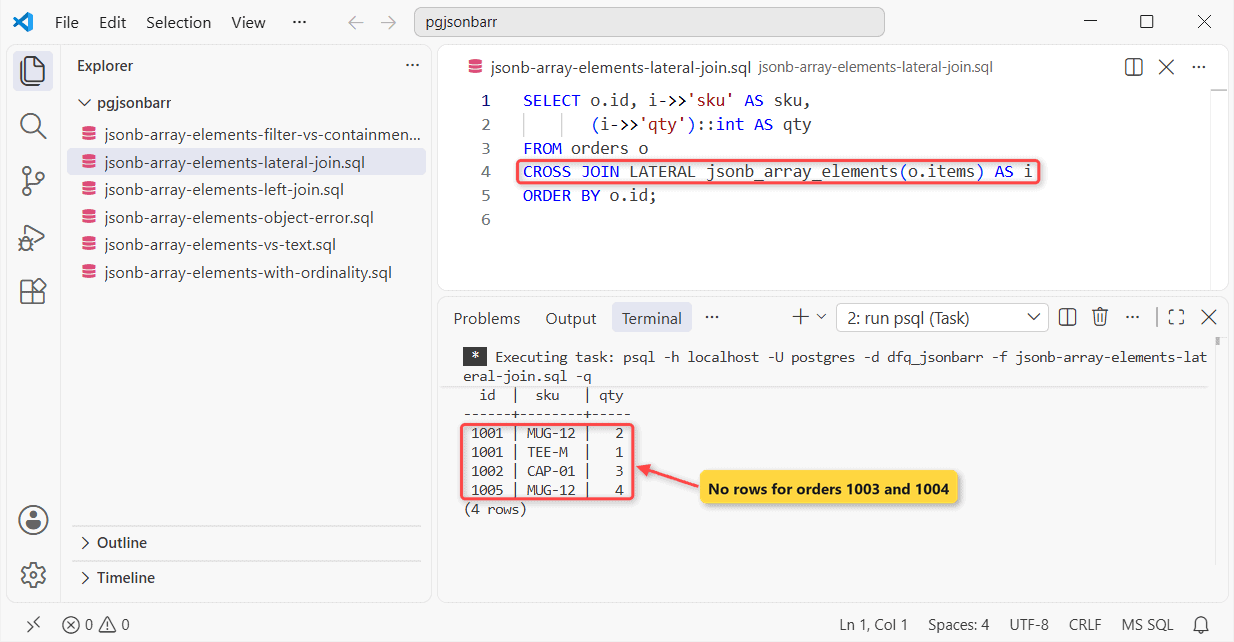
That returns 4 rows. ->> returns text, so cast qty before math. More on join types in my PostgreSQL joins tutorial.
Example 3: Keep Rows with Empty or NULL Arrays (LEFT JOIN LATERAL)
Say you need orders 1002 to 1004, even Grace’s empty array:
\pset null '(null)'

SELECT o.id, i->>'sku' AS sku
FROM orders o
LEFT JOIN LATERAL jsonb_array_elements(o.items) AS i
  ON true
WHERE o.id BETWEEN 1002 AND 1004
ORDER BY o.id;
Output:
  id  |  sku
------+--------
 1002 | CAP-01
 1003 | (null)
 1004 | (null)
(3 rows)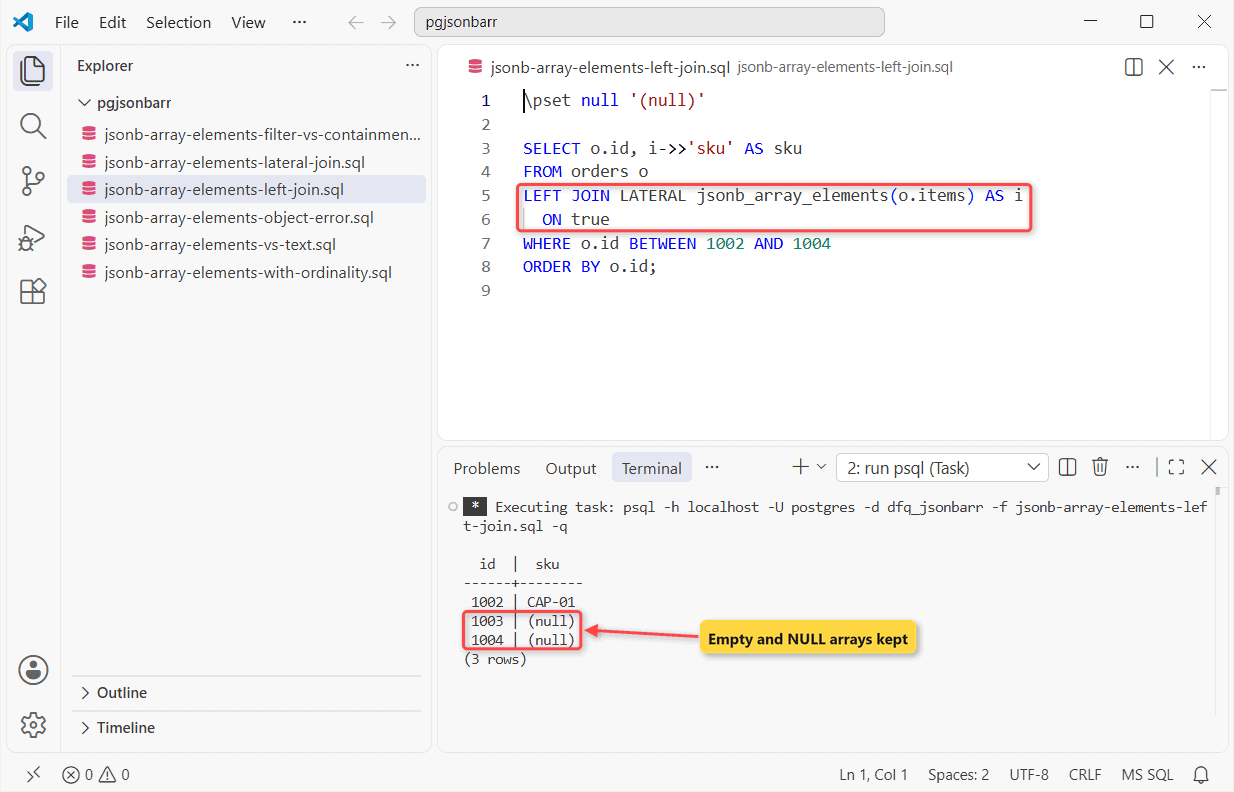
That returns 3 rows, with (null) for 1003 and 1004. Drop the WHERE, run the SELECT again, and you should see 6 rows. Swap NULL for a label with COALESCE.
Example 4: Get Each Element’s Position WITH ORDINALITY
Next, I want each item’s position in Hannah’s array:
SELECT x.n, x.item->>'sku' AS sku
FROM orders o,
     jsonb_array_elements(o.items) WITH ORDINALITY AS x(item, n)
WHERE o.id = 1001;
Output:
 n |  sku
---+--------
 1 | MUG-12
 2 | TEE-M
(2 rows)
MUG-12 is item 1 and TEE-M is item 2. To number by a sort instead, use ROW_NUMBER.
Example 5: Filter PostgreSQL Rows by an Array Element
I want to flag orders with an item of qty 3+, and orders holding MUG-12:
\pset footer off
SELECT id,
  EXISTS (SELECT 1 FROM jsonb_array_elements(items) AS i
          WHERE (i->>'qty')::int >= 3) AS qty_3_plus,
  items @> '[{"sku": "MUG-12"}]' AS has_mug
FROM orders
WHERE items IS NOT NULL
ORDER BY id;
Output:
  id  | qty_3_plus | has_mug
------+------------+---------
 1001 | f          | t
 1002 | t          | f
 1003 | f          | f
 1005 | t          | t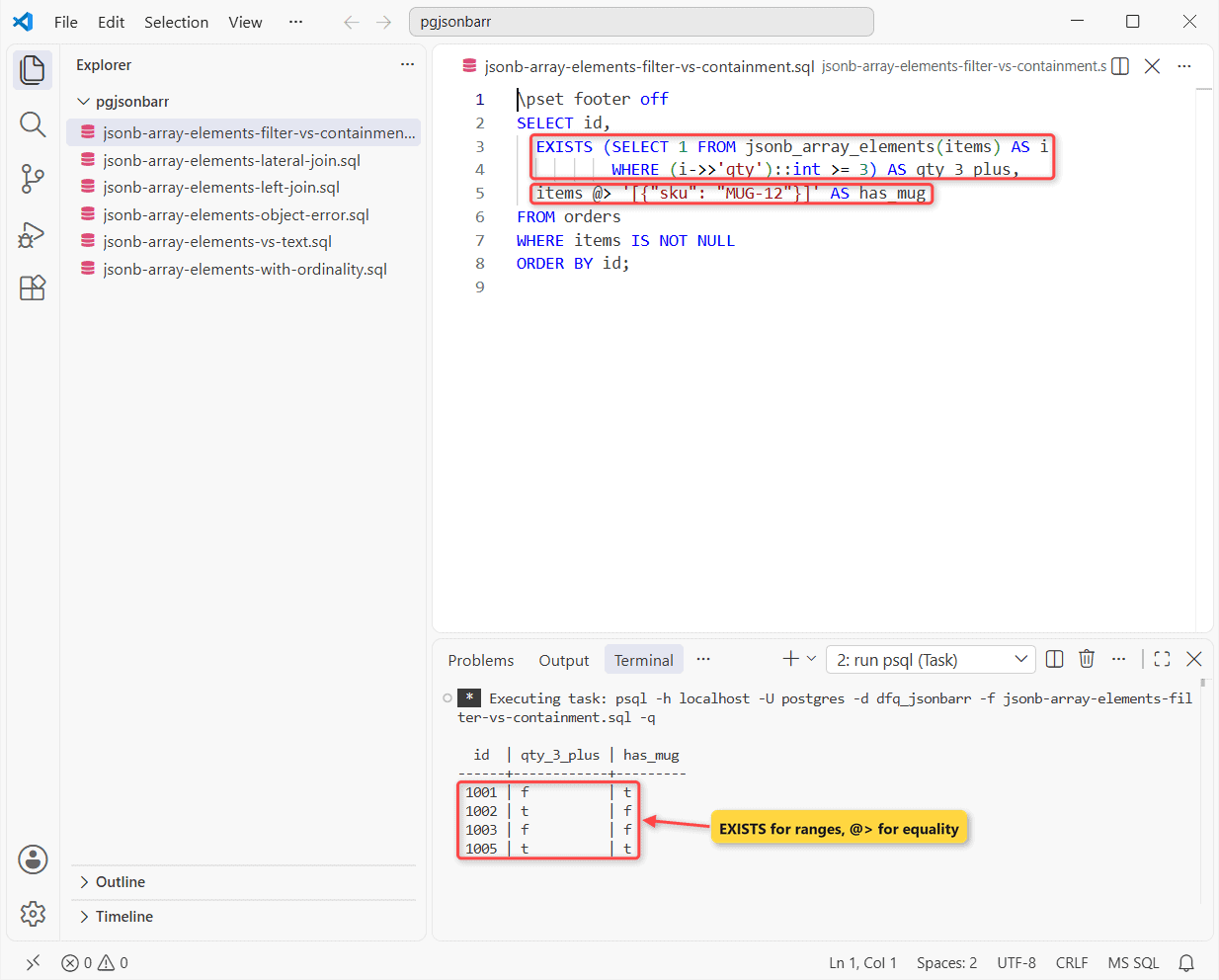
qty_3_plus is true for 1002 and 1005; has_mug is true for 1001 and 1005. @> only tests equality, so ranges need an EXISTS subquery.
Example 6: Fix “cannot extract elements from an object” in PostgreSQL
Order 1006 stores an object. The goal is a query that skips it:
\set ON_ERROR_STOP off

INSERT INTO orders VALUES
 (1006, 'Ava Turner', '{"sku":"CAP-01","qty":1}');

SELECT o.id, i->>'sku' AS sku
FROM orders o, jsonb_array_elements(o.items) AS i;

SELECT count(*)
FROM orders o, jsonb_array_elements(o.items) AS i
WHERE jsonb_typeof(o.items) = 'array';
Output:
psql:jsonb-array-elements-object-error.sql:7: ERROR:  cannot extract elements from an object
 count
-------
     4
(1 row)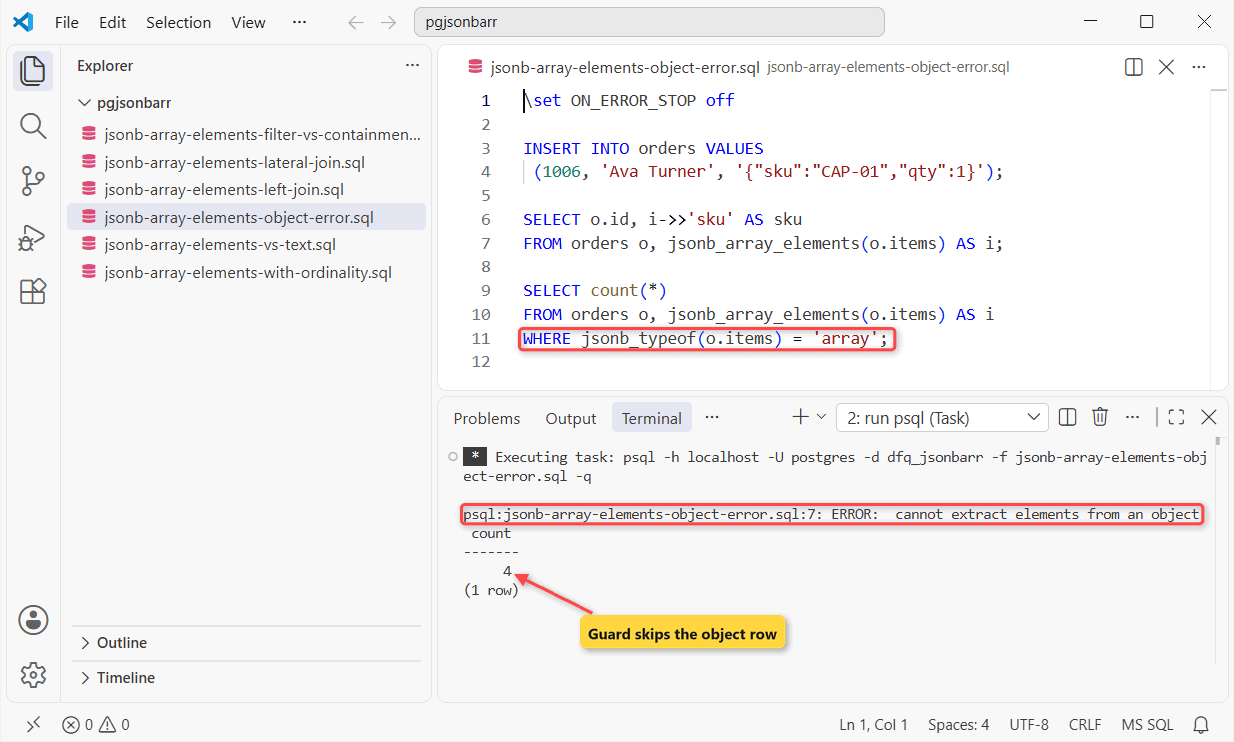
The plain query fails; the guarded one counts 4 rows. A string fails too, with cannot extract elements from a scalar.
jsonb_array_elements vs jsonb_path_query vs unnest: Which Should You Use?
| Feature | jsonb_array_elements | jsonb_path_query | unnest |
|---|---|---|---|
| Input | jsonb array | jsonb + path | SQL array |
| Object input | Error | Returns the object | n/a |
My rule of thumb: jsonb_array_elements for rows, jsonb_path_query for one field ('$[*].sku'), PostgreSQL UNNEST for array columns.
Tips & Common Mistakes
- Comma and CROSS joins drop empty or NULL arrays.
- Objects fail with
ERROR: cannot extract elements from an object. - Rebuild an array with
jsonb_agg(value). - A GIN index serves
@>, not the function. See PostgreSQL CREATE INDEX.
Wrapping Up
The PostgreSQL jsonb_array_elements function plus LEFT JOIN LATERAL covers most JSON-array reports. Copy Example 3 for reports. In MongoDB, $unwind does this job.
Next step: browse the complete list of PostgreSQL functions or the PostgreSQL 18 JSON functions docs.
Working with arrays in other ways? Start here:
Frequently Asked Questions
What is the difference between json_array_elements and jsonb_array_elements?
json_array_elements keeps each element’s original text. The jsonb version returns normalized jsonb.
How do I expand a nested JSON array in PostgreSQL?
Add a second LATERAL call on the inner array, like jsonb_array_elements(e->’tags’).
Is jsonb_array_elements slow on big tables?
It gets no index help. Filter with an indexed @> first, then expand.

Kumar Saurabh is a freelance software engineer who builds web and mobile apps with Next.js, React, Flutter and Python. From 2021 to 2024, Saurabh worked as an IT analyst and developer at TSInfo Technologies, writing technical articles on SQL and PostgreSQL. Saurabh writes the PostgreSQL, MySQL, MariaDB and MongoDB tutorials on DatabaseFAQs.com and holds a Master of Computer Applications (MCA) from Chandigarh University.