How to Create Database in PostgreSQL

How to Create Database in PostgreSQL
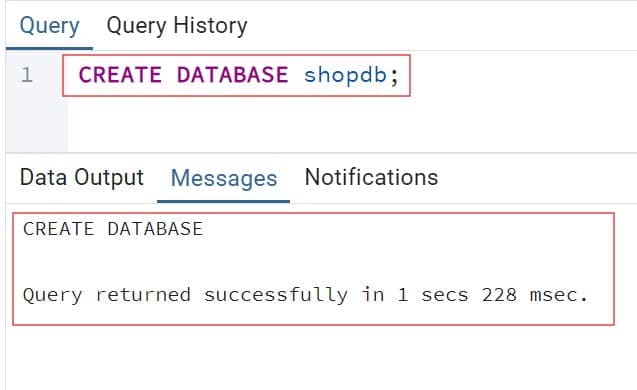
A web application starts with a database owned by its administrator account. That seems convenient until a deployment changes the wrong objects, an application bug has permission to delete tables, and nobody knows whether the latest backup can be restored. Learning how to create database in PostgreSQL involves more than running CREATE DATABASE. Ownership, application … Read more >>

PostgreSQL Unique Constraint

Postgresql unique constraint

A retail startup called me after their support team found two customer accounts with the same email address. Orders, loyalty points, and password resets were split across both records. The developers had checked for duplicates in application code, but two requests arrived at the same moment and both passed the check. The database accepted both … Read more >>

Drop Database PSQL

drop database psql list database using \l command

A developer on a client’s team opened two terminal tabs, one for staging and one for production. He meant to clean up an old test copy, typed the command in the wrong tab, and pressed Enter. Within a second, a production database with eight months of order history was gone. The team had backups, but … Read more >>

PostgreSQL List Databases

postgresql list databases with command line \l

A SaaS startup called me after its Azure bill jumped 40 percent in one month. Nobody knew why. When I connected to the server and ran one command, I found 23 databases. Eleven of them were old test copies, and one held a full production backup that a contractor had restored and forgotten. The team … Read more >>

PostgreSQL While Loop

Postgresql while loop update

A retail team I worked with had a nightly cleanup job that deleted two years of closed orders in one statement. At 2 a.m. it locked the orders table, filled the transaction log, and pushed storage close to its limit. The checkout API started timing out before the job finished. Their first fix was a … Read more >>

PostgreSQL Schema

PostgreSQL Schema

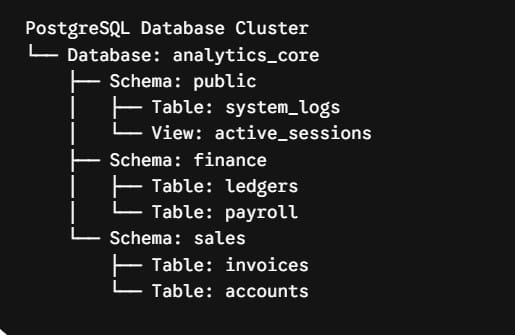
In this tutorial, I will guide you through the architecture, administration, security models, and lifecycle management of PostgreSQL schemas. Understanding schemas is fundamental to running clean, performant, and secure PostgreSQL clusters. PostgreSQL Schema What Is a PostgreSQL Schema? A PostgreSQL cluster contains one or more named databases. Within each database, you have one or more … Read more >>

PostgreSQL ANALYZE

PostgreSQL ANALYZE

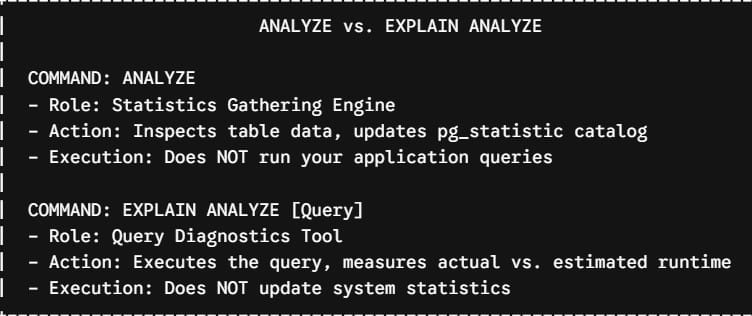
The ANALYZE command is PostgreSQL’s built-in engine for statistical discovery. In this article, I will walk you through the architectural mechanics of ANALYZE, how PostgreSQL builds distribution histograms, how to configure Autovacuum for optimal statistics collection, and the advanced tuning strategies required for high-throughput enterprise databases. PostgreSQL ANALYZE What Is PostgreSQL ANALYZE and Why Does … Read more >>

PostgreSQL SELECT

PostgreSQL SELECT

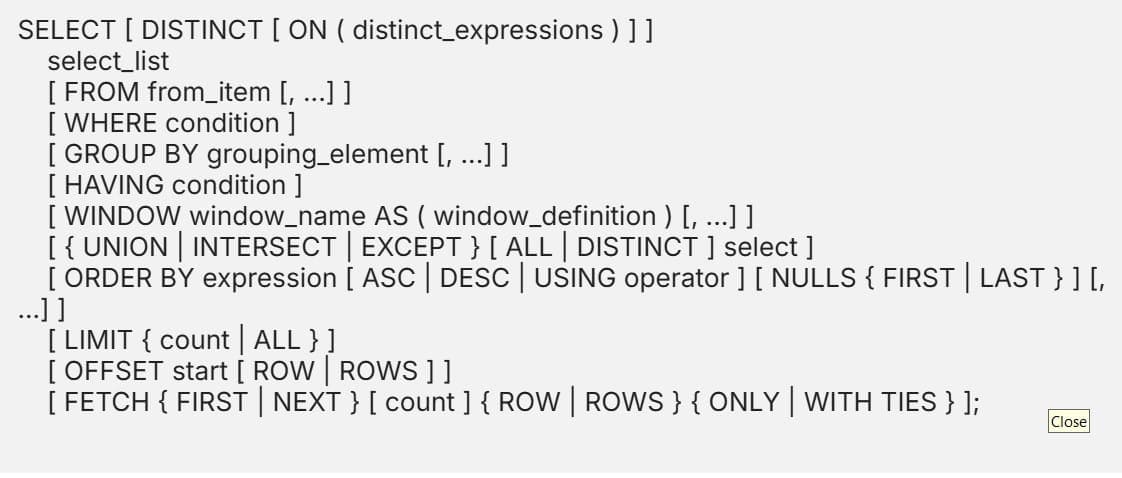
In this article, I will guide you through the full spectrum of the PostgreSQL SELECT statement—from core syntax and logical execution order to advanced pattern matching, relational joins, Common Table Expressions (CTEs), window functions, and query optimization strategies. PostgreSQL SELECT The Anatomy of a PostgreSQL SELECT Statement The SELECT statement retrieves rows from one or … Read more >>

PostgreSQL VACUUM vs VACUUM FULL

PostgreSQL VACUUM vs VACUUM FULL

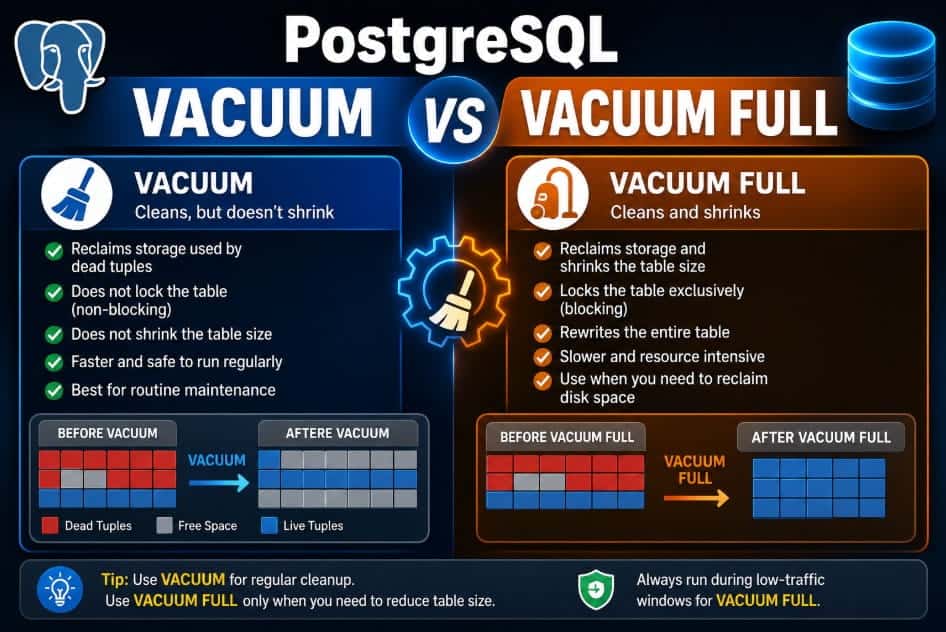
In this tutorial, I will break down how standard VACUUM and VACUUM FULL operate in depth, their locking mechanisms and disk space implications, and how to safely maintain high-throughput PostgreSQL environments. PostgreSQL VACUUM vs VACUUM FULL What Is Standard VACUUM (and Autovacuum)? Standard VACUUM (often executed simply as VACUUM or handled in the background by … Read more >>

MySQL Joins

MySQL joins

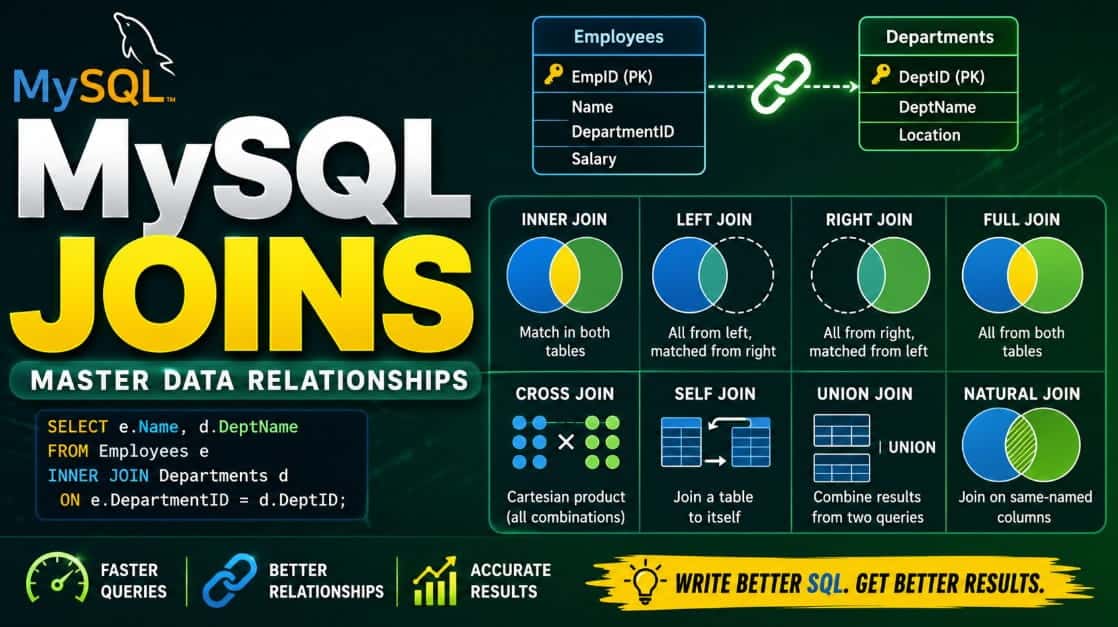
Mastering MySQL joins is essential for maintaining query optimization. Let’s break down the underlying mechanics of the MySQL join, compare individual join strategies side by side, and map out the exact optimization patterns required to execute relational queries at scale. MySQL Joins Core Mechanics: How the MySQL Query Optimizer Processes Joins Before typing out any … Read more >>