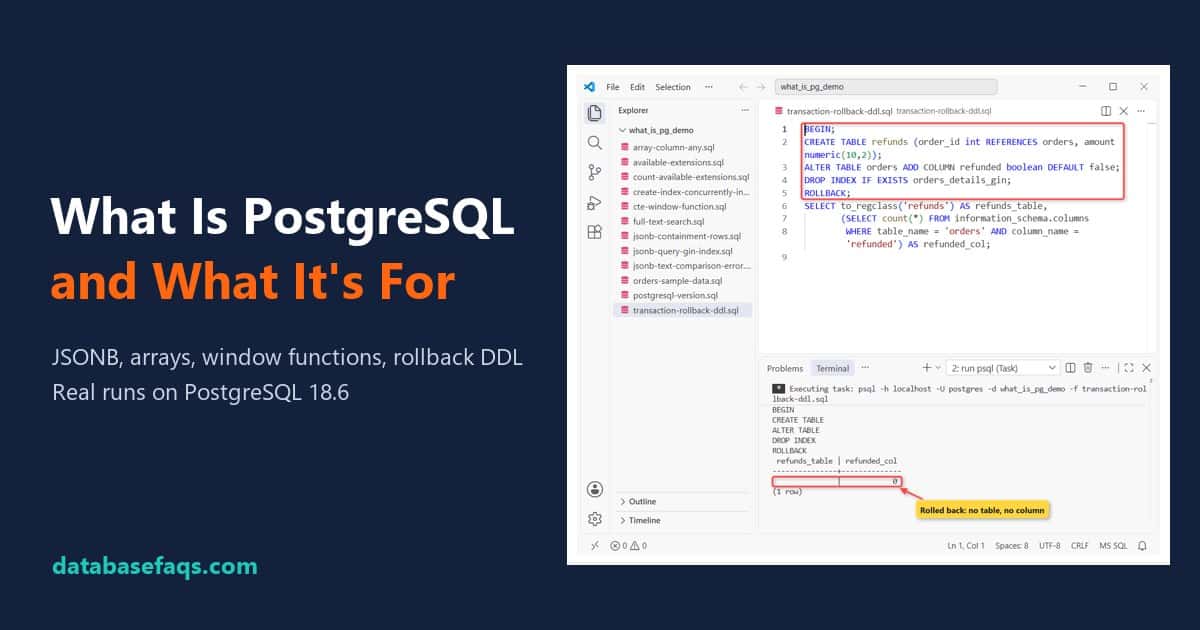
Why Use PostgreSQL

Why Use PostgreSQL

In this tutorial, I will walk you through the authoritative reasons why you should choose PostgreSQL for your next project, the technical features that set it apart, and how it handles the demands of an AI-driven world. Why Use PostgreSQL If you ask an experienced engineer today what database to start with, nine times out … Read more >>

How To Check PostgreSQL Version

How To Check PostgreSQL Version

One of the first questions I ask when stepping into a new project is: “What version of PostgreSQL are we running?”. Whether you’re a developer or a DBA, knowing how to check your PostgreSQL version is the fundamental first step in database management. In this article, I’ll show you exactly how to find that information … Read more >>

PostgreSQL Certification

PostgreSQL Certification Guide

If you are looking to solidify your expertise and command a higher salary in the competitive US tech market, obtaining a PostgreSQL certification is one of the smartest moves you can make. In this guide, I will walk you through everything you need to know about getting certified, from choosing the right path to mastering … Read more >>

Could Not Connect to PostgreSQL Server

Could Not Connect to PostgreSQL Server

In this comprehensive tutorial, I will walk you through my battle-tested, step-by-step framework for diagnosing, isolating, and resolving the “Could Not Connect to PostgreSQL Server” error. We will bypass the guesswork and systematically pinpoint the failure so you can get your systems back online safely. Could Not Connect to PostgreSQL Server Understanding the PostgreSQL Connection … Read more >>

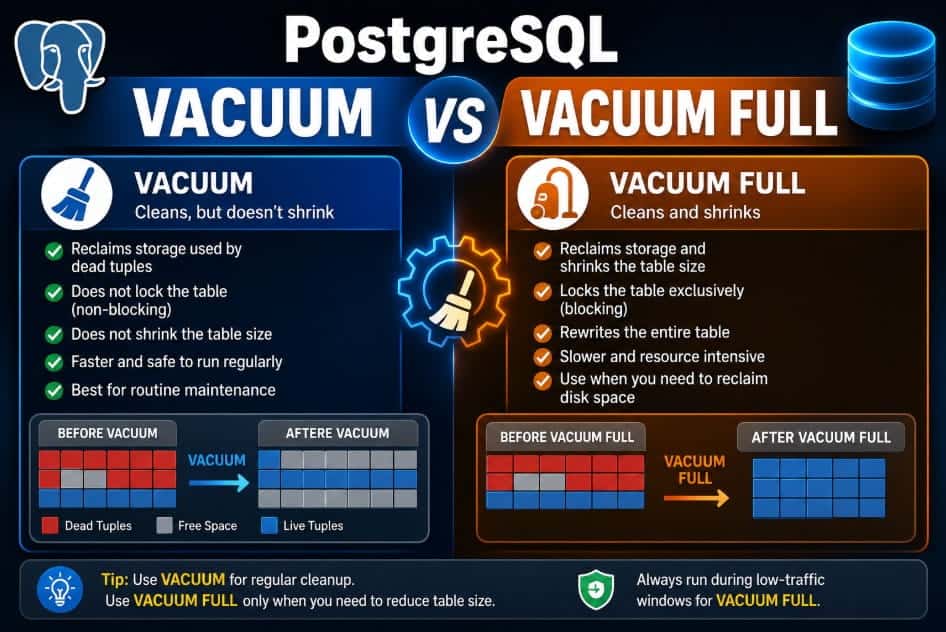
PostgreSQL VACUUM vs VACUUM FULL

PostgreSQL VACUUM vs VACUUM FULL

In this tutorial, I will break down how standard VACUUM and VACUUM FULL operate in depth, their locking mechanisms and disk space implications, and how to safely maintain high-throughput PostgreSQL environments. PostgreSQL VACUUM vs VACUUM FULL What Is Standard VACUUM (and Autovacuum)? Standard VACUUM (often executed simply as VACUUM or handled in the background by … Read more >>

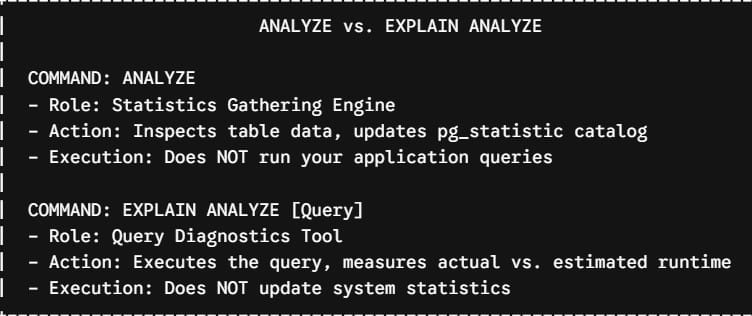
PostgreSQL ANALYZE

PostgreSQL ANALYZE

The ANALYZE command is PostgreSQL’s built-in engine for statistical discovery. In this article, I will walk you through the architectural mechanics of ANALYZE, how PostgreSQL builds distribution histograms, how to configure Autovacuum for optimal statistics collection, and the advanced tuning strategies required for high-throughput enterprise databases. PostgreSQL ANALYZE What Is PostgreSQL ANALYZE and Why Does … Read more >>

Left Outer Join vs Right Outer Join in SQL Server (Tested)

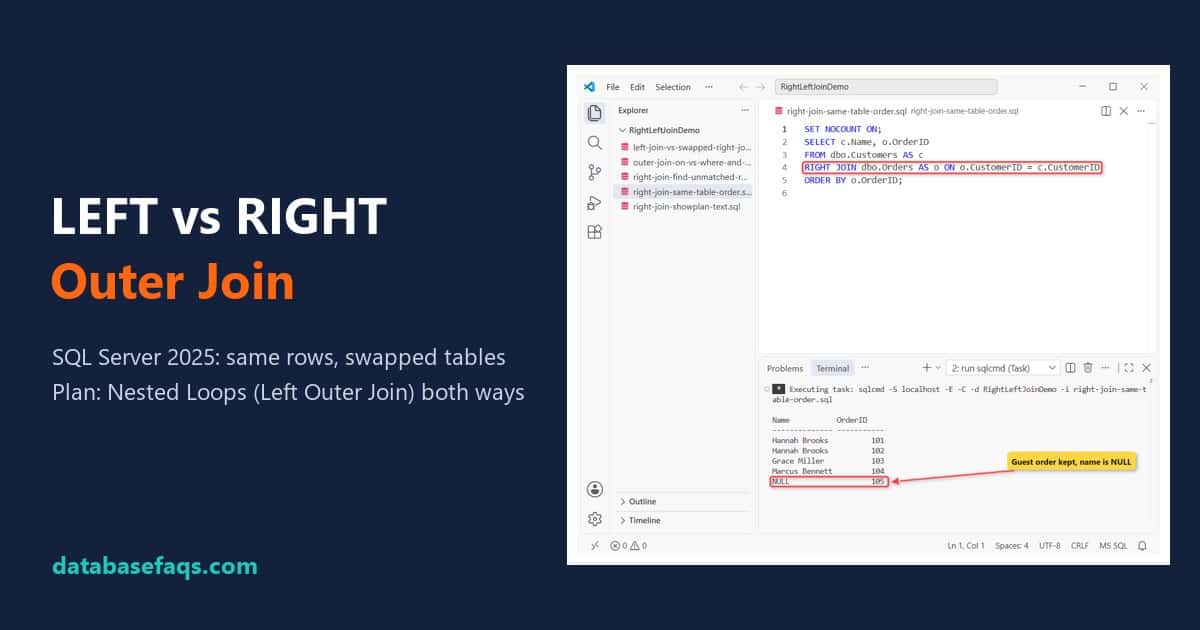
Left outer join vs right outer join in SQL Server: RIGHT JOIN output with guest order 105

Picking between LEFT and RIGHT for a report query? The whole left outer join vs right outer join SQL Server question comes down to which table keeps all its rows. Swap the table order and both return identical results. So use LEFT JOIN with the must-keep table first. That’s the convention. Left Outer Join vs … Read more >>

PostgreSQL Export Table to CSV: COPY, \copy and pgAdmin

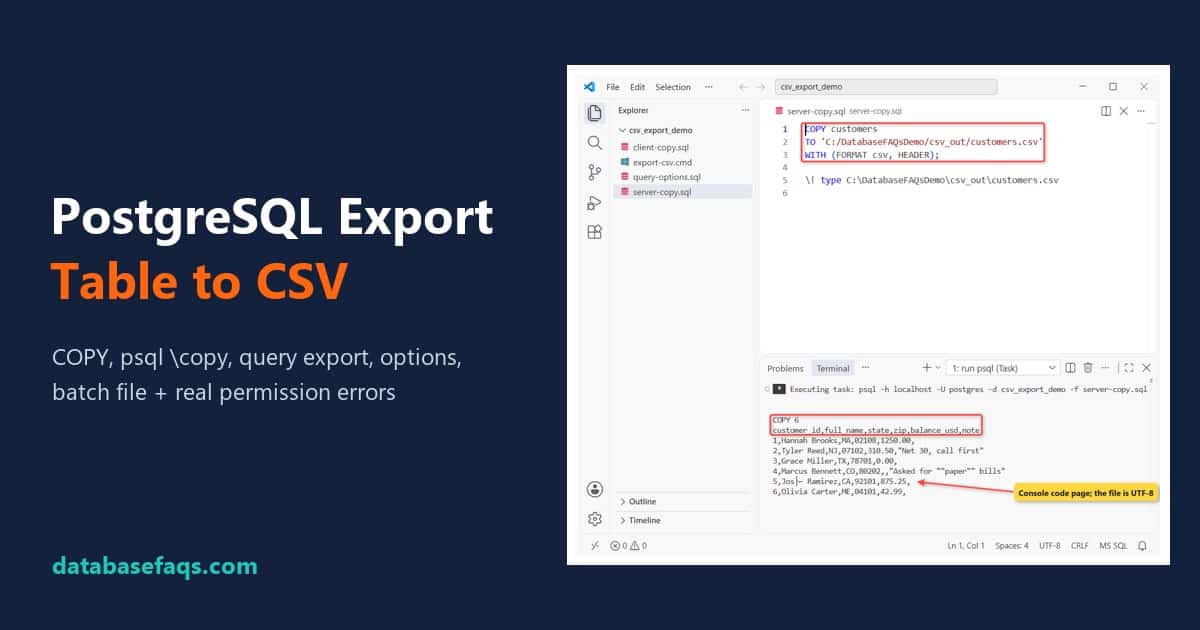
PostgreSQL export table to CSV with COPY and psql copy, run in VS Code

If you need a PostgreSQL export table to CSV file, run psql’s \copy. It works for any role that can read the table: Superusers can also use server-side COPY. I ran every COPY and psql command below on PostgreSQL 18.6 on Windows 11, errors included. The sample customers table Six US customers with the rows … Read more >>