MariaDB TINYINT

MariaDB TINYINT

In this article, I’m going to walk you through everything you need to know about the TINYINT data type. We’ll cover ranges, storage, and a few “pro tips” that will save you from common pitfalls. MariaDB TINYINT What is MariaDB TINYINT? At its core, TINYINT is the smallest integer data type available in MariaDB. While … Read more >>
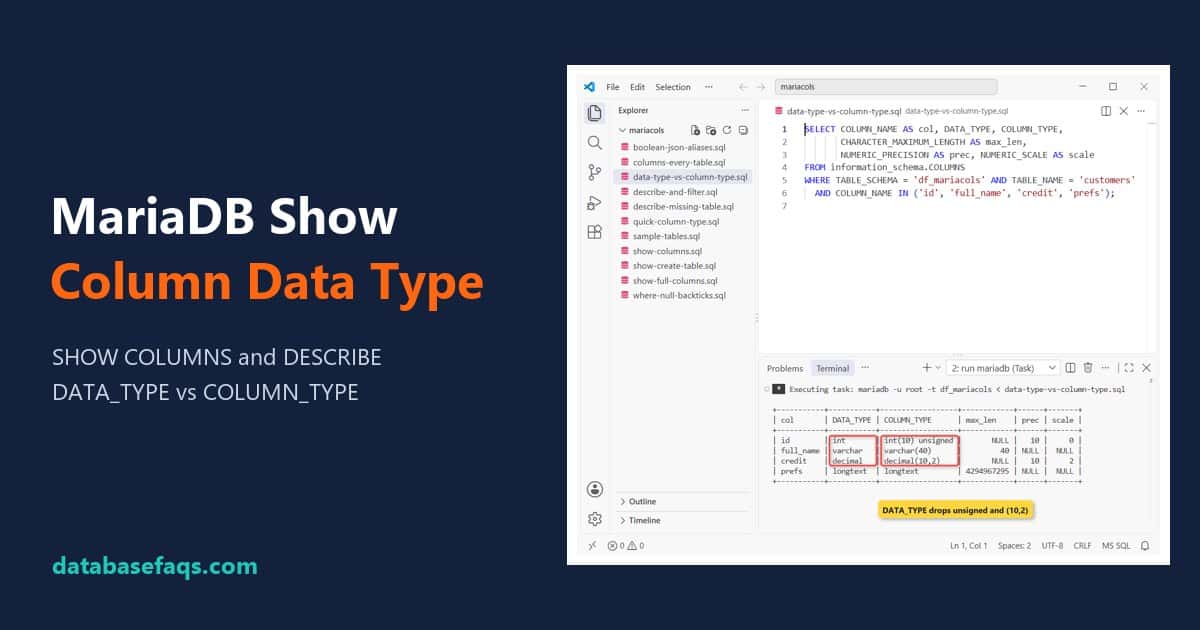
MariaDB Show Column Data Type: SHOW COLUMNS vs information_schema

MariaDB show column data type: information_schema DATA_TYPE vs COLUMN_TYPE in VS Code

Use COLUMN_TYPE from information_schema.COLUMNS when a script needs the MariaDB show column data type answer. Use DESCRIBE when you’re just looking: Three columns, three surprises: That’s my verdict after testing each method on MariaDB 13.0.2. I declared is_active as BOOLEAN and prefs as JSON. Neither survived. The Sample Tables I Tested On Every query below … Read more >>

SQL Server OUTER JOIN + Examples

Sql server outer join

In the SQL Server tutorial, we will learn how to use SQL Server OUTER JOIN clause on both tables by the query. The following is a list of the subtopics that will be covered: SQL Server Outer Join In SQL Server, the FULL OUTER JOIN clause returns a result set that includes rows from the … Read more >>

Delete From With Join in SQL Server

Example of delete from with join in Sql server

In this SQL Server tutorial, we will learn and understand how to use the SQL Server DELETE statement with the JOIN clause on tables by the query. Recently, I was working on an Employee Management System Project where it was required to use the DELETE statement with the JOIN clause in the SQL Server. So, … Read more >>

SQL Server Inner Join with Like

Sql server inner join with like clause example

In this SQL Server tutorial, we will learn and understand how to use the SQL Server INNER JOIN with the LIKE clause on tables by the query. Recently, I got a requirement to join multiple tables and even filter records based on the condition for the resultset in SQL Server. So, I came across the … Read more >>

SQL Server FULL OUTER JOIN with WHERE clause

Sql server full outer join with where clause example

In this SQL Server tutorial, we will learn and understand how to use the SQL Server FULL OUTER JOIN with WHERE clause on tables by the query. Recently, I got a requirement to join multiple tables and even filter records based on the condition for the resultset in the SQL Server. So, I came across … Read more >>

SQL Server INNER JOIN

Sql server inner join image

Recently, I was working on the Employee Attendance Management System Project, where I retrieved all records using the INNER JOIN clause. So, here we will focus on how to use the INNER JOIN clause on the tables. In this SQL Server tutorial, we will learn and understand how to use the SQL Server INNER JOIN clause on tables using … Read more >>

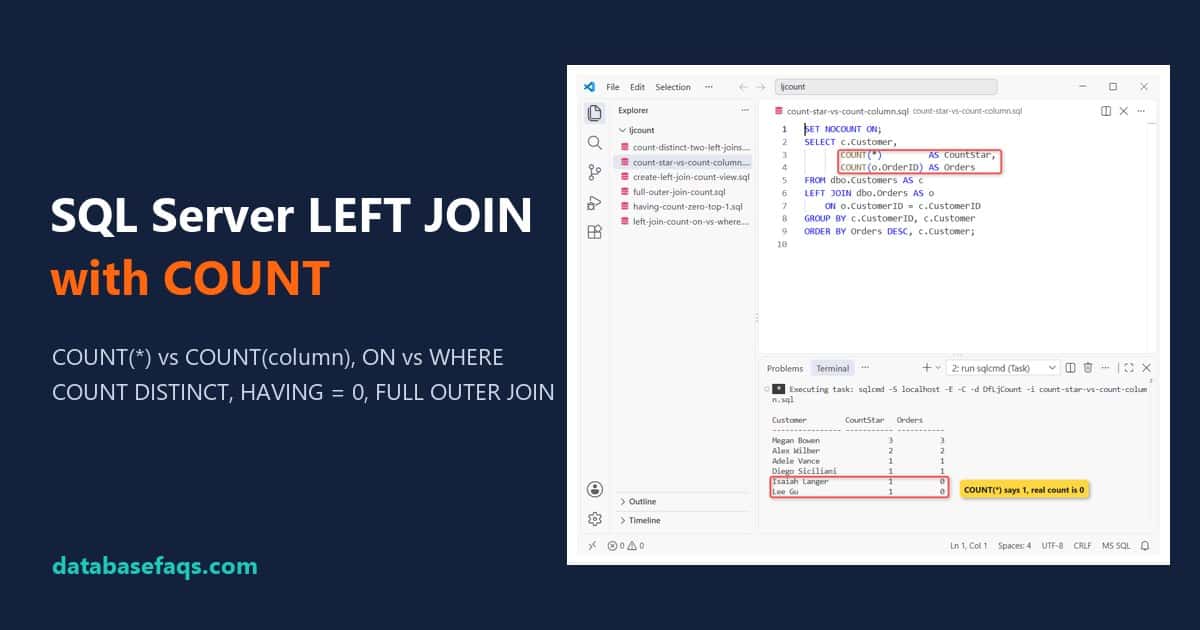
SQL Server LEFT JOIN With COUNT: Get 0 for Rows With No Match

SQL Server LEFT JOIN with COUNT returning 0 for customers without orders

Isaiah Langer has never placed an order, yet my first sql server left join with count query gave him one. Count a column from the right table, not the row: SELECT c.Customer, COUNT(o.OrderID) AS Orders FROM dbo.Customers AS c LEFT JOIN dbo.Orders AS o ON o.CustomerID = c.CustomerID GROUP BY c.Customer; An unmatched customer still … Read more >>

How to use ilike in PostgreSQL

ILIKE Case Insensitive in PostgreSQL Percent Sign

In this PostgreSQL tutorial, I will show how to use ILIKE in PostgreSQL. You will learn about using the ILIKE case-insensitive with columns in the table. Also, learn how to use the wildcards like underscore (_) and percent symbol (%) with ILIKE case-insensitive. How to use ilike in PostgreSQL Let’s discuss all possible cases, along … Read more >>

How to Rename Column in PostgreSQL

Renaming Column How to Rename Column If Exists in PostgreSQL

In this PostgreSQL tutorial, I will show you how to rename column in PostgreSQL, where you will understand how to check the column’s existence in the table before renaming the column. How to Rename Column in PostgreSQL Sometimes, as business requirements change, you also need to rename the columns, and there can be different reasons … Read more >>