
Use EOMONTH. The SQL Server last day of month is one call, and a second argument shifts months:
SELECT EOMONTH('2026-03-14')     AS LastDay,   /* 2026-03-31 */
       EOMONTH('2026-03-14', -1) AS PrevMonth, /* 2026-02-28 */
       EOMONTH(GETDATE())        AS ThisMonth;
It returns a date, never a time. Tested on SQL Server 2025 Developer (17.0.1000.7). EOMONTH needs SQL Server 2012 or later.
EOMONTH Syntax: EOMONTH(start_date [, month_to_add])
start_date is any date type or date string; month_to_add is an integer offset. Leap-year February 2028 included:
SET NOCOUNT ON;
DECLARE @d datetime = '2026-03-14 15:45';
SELECT EOMONTH(@d)     AS ThisMonth,
       EOMONTH(@d, -1) AS PrevMonth,
       EOMONTH(@d, 1)  AS NextMonth,
       EOMONTH('2028-02-10') AS LeapFeb,
       CAST(SQL_VARIANT_PROPERTY(EOMONTH(@d), 'BaseType')
            AS varchar(8)) AS ReturnType;

SELECT EOMONTH(SYSUTCDATETIME()) AS ThisMonthUtc;
My run:
ThisMonth        PrevMonth        NextMonth        LeapFeb          ReturnType
---------------- ---------------- ---------------- ---------------- ----------
      2026-03-31       2026-02-28       2026-04-30       2028-02-29 date
ThisMonthUtc
----------------
      2026-11-30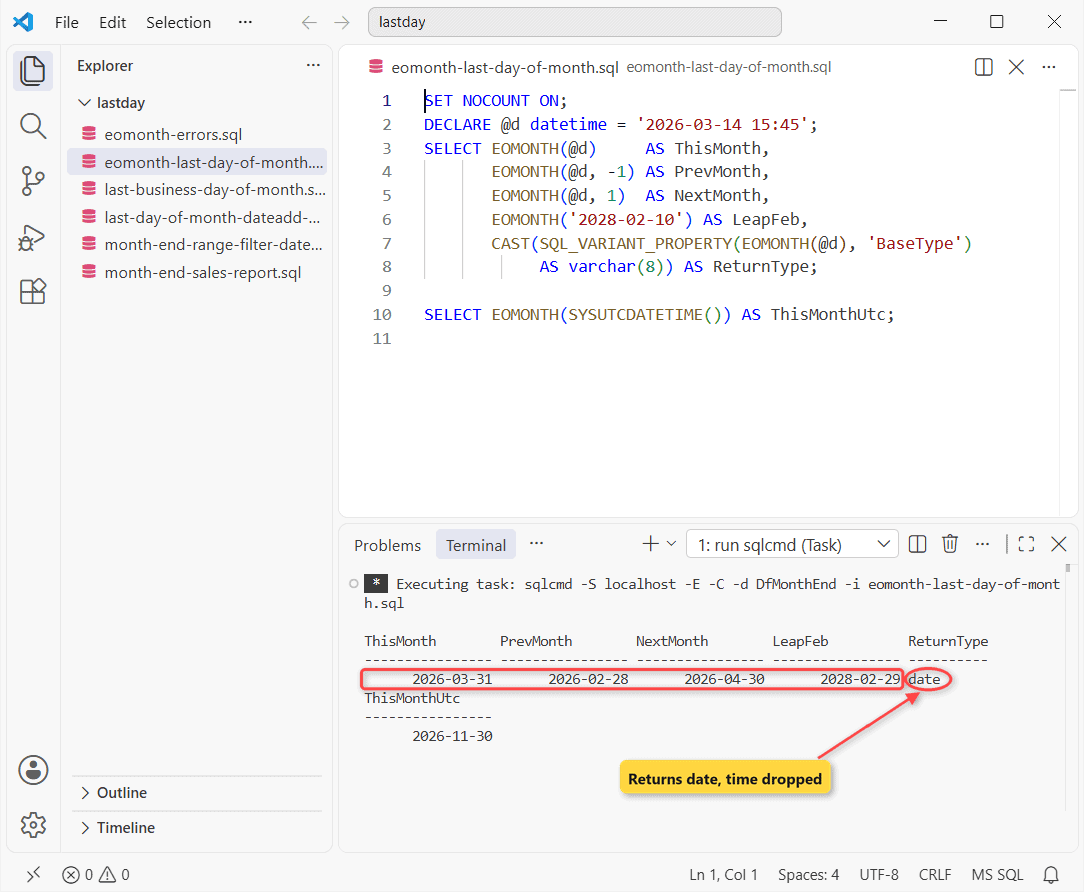
The datetime input came back as date, so 15:45 is gone, and you don’t need any leap-year logic. The UTC row gave 11/30/2026; pass SYSUTCDATETIME() when the server clock isn’t UTC.
Variations: Previous Month, Next Month, Quarter and Year
| You want | Query |
|---|---|
| Last day of previous month | EOMONTH(GETDATE(), -1) |
| Last day of next month | EOMONTH(GETDATE(), 1) |
| Last day of quarter | EOMONTH(DATEFROMPARTS(YEAR(@d), DATEPART(quarter, @d) * 3, 1)) |
| Last day of year | DATEFROMPARTS(YEAR(@d), 12, 31) |
| First day of the month | DATEADD(day, 1, EOMONTH(@d, -1)) |
For 08/19/2026 the quarter row gave 09/30/2026 on my run. Start-of-month patterns live in the SQL Server first day of month guide.
Last Day of Month Without EOMONTH (SQL Server 2008 and DATETRUNC)
Pre-2012 code uses the DATEADD/DATEDIFF trick. DATETRUNC (SQL Server 2022+) reads better:
SET NOCOUNT ON;
DECLARE @d datetime = '2026-02-14 15:45';
SELECT DATEADD(day, -1,
         DATEADD(month, DATEDIFF(month, 0, @d) + 1, 0))
         AS OldWay,
       DATEADD(day, -1,
         DATEADD(month, 1, DATETRUNC(month, @d))) AS ViaDatetrunc,
       DAY(EOMONTH(@d)) AS DaysInMonth;
Same answer twice:
OldWay                  ViaDatetrunc            DaysInMonth
----------------------- ----------------------- -----------
2026-02-28 00:00:00.000 2026-02-28 00:00:00.000          28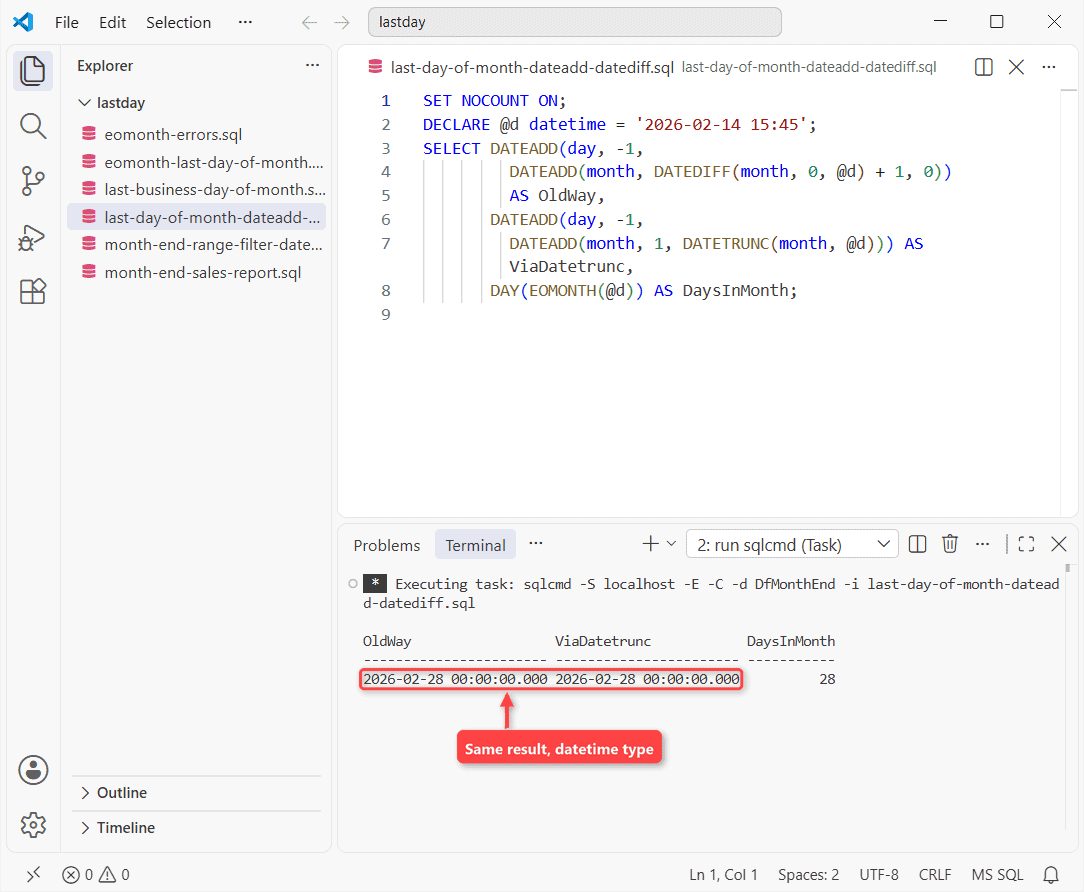
Both return datetime midnight; DATETRUNC keeps the input type (see datetime vs datetime2). Don’t use the DATEADD(s, -1, ...) variant; you’ll miss the last second.
Why Does My EOMONTH Filter Miss Orders on the Last Day?
EOMONTH returns midnight, so on a datetime column BETWEEN ... AND EOMONTH(@d) stops at 03/31/2026 00:00. Sample table:
CREATE TABLE dbo.Orders (
    OrderId   int IDENTITY(1,1) PRIMARY KEY,
    Customer  nvarchar(15)  NOT NULL,
    Total     decimal(10,2) NOT NULL,
    OrderDate datetime      NOT NULL
);
INSERT INTO dbo.Orders (Customer, Total, OrderDate) VALUES
(N'Hannah Brooks', 120.00, '2026-02-27 09:15'),
(N'Tyler Reed',  89.99, '2026-02-28 16:40'),
(N'Grace Miller',  45.50, '2026-03-02 10:05'),
(N'Marcus Bennett', 310.00, '2026-03-18 13:30'),
(N'Kayla Parker',  72.25, '2026-03-31 00:00'),
(N'Jordan Cole',  18.75, '2026-03-31 14:20'),
(N'Ethan Price', 250.00, '2026-03-31 21:45'),
(N'Olivia Grant',  64.10, '2026-04-01 08:00');
Both filters for March:
SET NOCOUNT ON;
DECLARE @d date = '2026-03-14';
SELECT 'BETWEEN EOMONTH' AS Filter, COUNT(*) AS Orders,
       CAST(SUM(Total) AS decimal(10,2)) AS Sales
FROM dbo.Orders
WHERE OrderDate BETWEEN DATETRUNC(month, @d) AND EOMONTH(@d)
UNION ALL
SELECT '< EOMONTH + 1', COUNT(*), SUM(Total)
FROM dbo.Orders
WHERE OrderDate >= DATETRUNC(month, @d)
  AND OrderDate <  DATEADD(day, 1, EOMONTH(@d));
Counts:
Filter          Orders      Sales
--------------- ----------- ----------------------------------------
BETWEEN EOMONTH           3                                   427.75
< EOMONTH + 1             5                                   696.50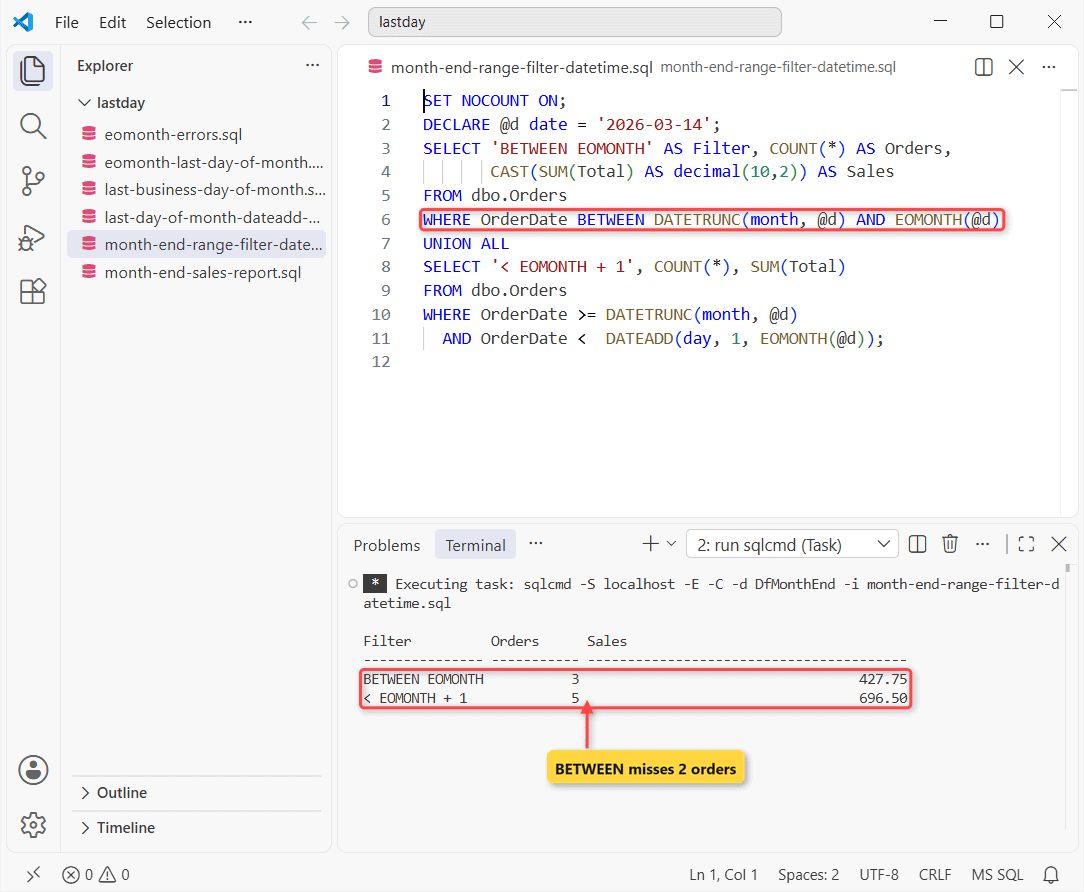
BETWEEN lost two orders and $268.75. Use a half-open range, >= first day AND < DATEADD(day, 1, EOMONTH(@d)), and an index on OrderDate can still seek. On a date column BETWEEN is fine (see converting datetime to date).
Month-End Sales Report Grouped by EOMONTH
EOMONTH makes a clean month key for GROUP BY:
SET NOCOUNT ON;
SELECT EOMONTH(OrderDate) AS MonthEnd,
       COUNT(*)           AS Orders,
       CAST(SUM(Total) AS decimal(10,2)) AS Sales
FROM dbo.Orders
GROUP BY EOMONTH(OrderDate)
ORDER BY MonthEnd;
Report:
MonthEnd         Orders      Sales
---------------- ----------- ------------
      2026-02-28           2       209.99
      2026-03-31           5       696.50
      2026-04-30           1        64.10
March: 5 orders, $696.50. For “March 2026” labels, get the month name from the date.
Last Business Day of the Month
Step back from Saturday or Sunday. I count days from 01/01/1900 (a Monday), so DATEFIRST can’t change it:
SET NOCOUNT ON;
SELECT m.MonthEnd,
       LEFT(DATENAME(weekday, m.MonthEnd), 3) AS Dow,
       DATEADD(day, CASE DATEDIFF(day, '19000101', m.MonthEnd) % 7
                      WHEN 5 THEN -1 WHEN 6 THEN -2 ELSE 0 END,
               m.MonthEnd) AS LastWeekday
FROM (VALUES (EOMONTH('2026-01-01')), (EOMONTH('2026-03-01')),
             (EOMONTH('2026-05-01')), (EOMONTH('2026-10-01'))) AS m(MonthEnd);

SET DATEFIRST 1;
SELECT DATEPART(weekday, '2026-05-31') AS SundayIsNow;
Weekdays:
MonthEnd         Dow LastWeekday
---------------- --- ----------------
      2026-01-31 Sat       2026-01-30
      2026-03-31 Tue       2026-03-31
      2026-05-31 Sun       2026-05-29
      2026-10-31 Sat       2026-10-30
SundayIsNow
-----------
          7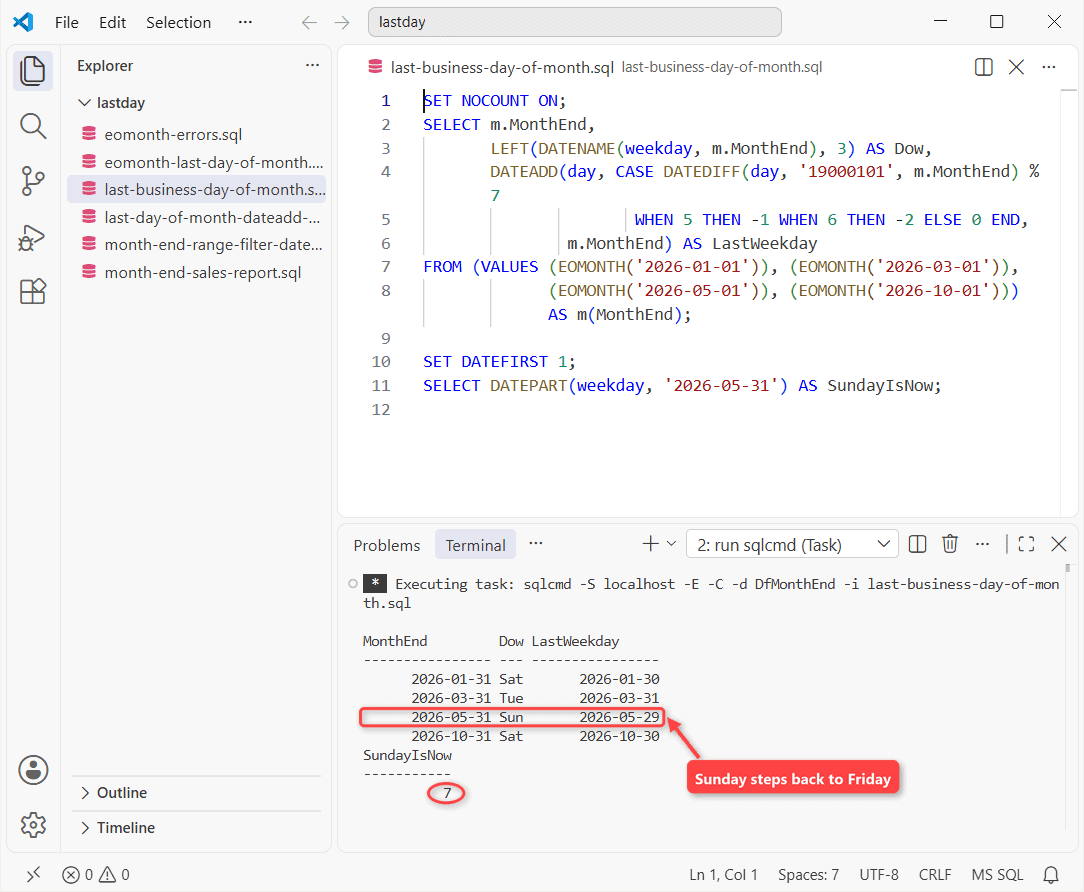
Watch that 7. Under SET DATEFIRST 1 Sunday is day 7, so a DATEPART(weekday, ...) IN (1, 7) weekend test written for the US default flags Mondays and lets Saturdays through. Holidays need a calendar table.
Gotchas I Hit With EOMONTH
SET NOCOUNT ON;
DECLARE @r date;
BEGIN TRY SET @r = EOMONTH('9999-12-15', 1); END TRY
BEGIN CATCH PRINT CONCAT('Msg ', ERROR_NUMBER(), ': ', ERROR_MESSAGE()); END CATCH;

BEGIN TRY SET @r = EOMONTH('2026-02-30'); END TRY
BEGIN CATCH PRINT CONCAT('Msg ', ERROR_NUMBER(), ': ', ERROR_MESSAGE()); END CATCH;

SET @r = EOMONTH('2026-03-14', 1.9);
PRINT CONCAT('Offset 1.9 gives ', @r);
What sqlcmd printed:
Msg 517: Adding a value to a 'date' column caused an overflow.
Msg 241: Conversion failed when converting date and/or time from character string.
Offset 1.9 gives 2026-04-30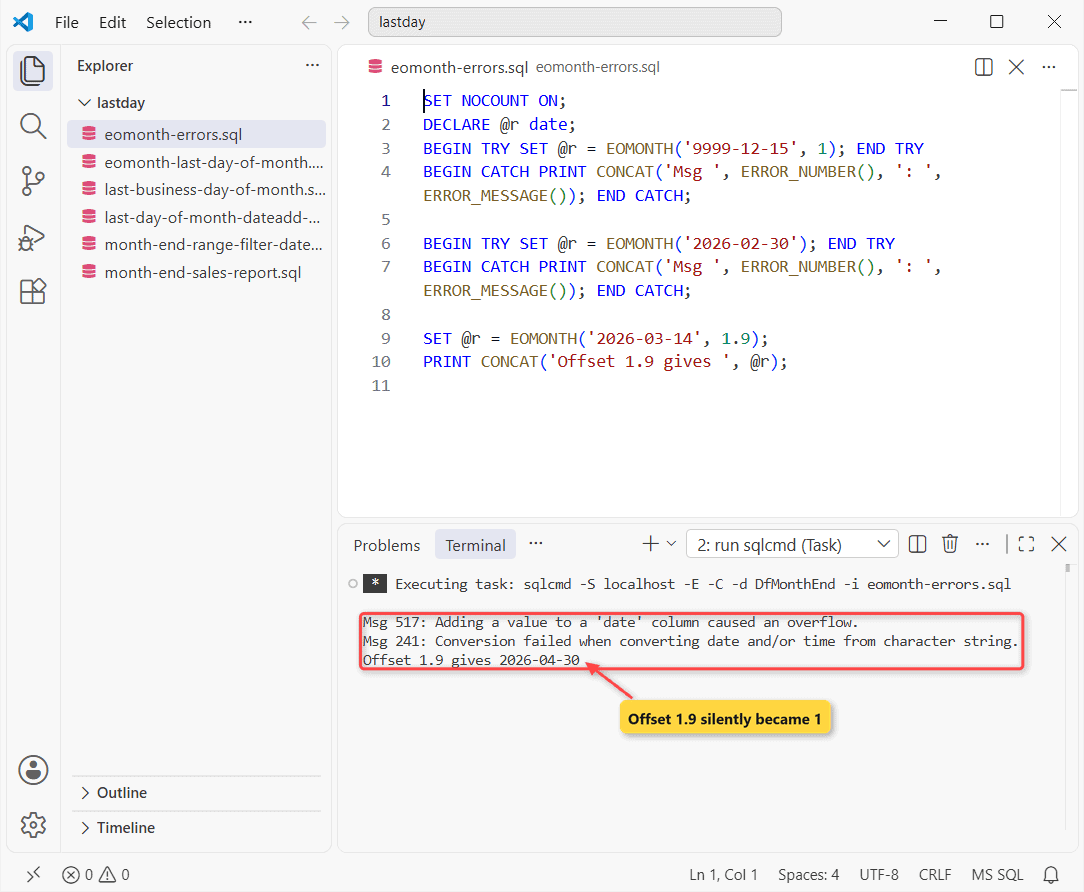
- Msg 517: an offset past 9999-12-31 overflows.
- Msg 241: ‘2026-02-30’ fails conversion before EOMONTH runs. See fixing the conversion failed error.
- Offset 1.9 became 1, silently.
- Compare with GETDATE() or CURRENT_TIMESTAMP gives the server’s month, not the user’s.
Copy-ready March filter:
DECLARE @d date = '2026-03-14';
SELECT OrderId, Customer, Total
FROM dbo.Orders
WHERE OrderDate >= DATEADD(day, 1, EOMONTH(@d, -1))
AND OrderDate < DATEADD(day, 1, EOMONTH(@d));- More date math: SQL Server datetime functions
- Format the month-end date for reports
- On Postgres? PostgreSQL date_trunc
Frequently Asked Questions
Does EOMONTH work in Azure SQL Database?
Yes. Per the EOMONTH reference, also Managed Instance, Synapse and Fabric.
How do I get the last day of the month from a month and year?
Build a date first: EOMONTH(DATEFROMPARTS(2026, 6, 1)) returns 2026-06-30.
Can I index a computed column that uses EOMONTH?
Yes. EOMONTH(OrderDate) PERSISTED is deterministic and took an index on my run. Under sqlcmd, run SET QUOTED_IDENTIFIER ON first or CREATE TABLE fails with Msg 1934.

Shivam Dogra is a cloud database developer and Team Lead at TSInfo Technologies, where he has worked since June 2021. He writes the SQL Server and Oracle tutorials on DatabaseFAQs.com, covering queries, joins, stored procedures, triggers and permissions. Shivam holds a Master of Computer Applications (MCA) from Chandigarh University.