
Isaiah Langer has never placed an order, yet my first sql server left join with count query gave him one.
Count a column from the right table, not the row: SELECT c.Customer, COUNT(o.OrderID) AS Orders FROM dbo.Customers AS c LEFT JOIN dbo.Orders AS o ON o.CustomerID = c.CustomerID GROUP BY c.Customer;
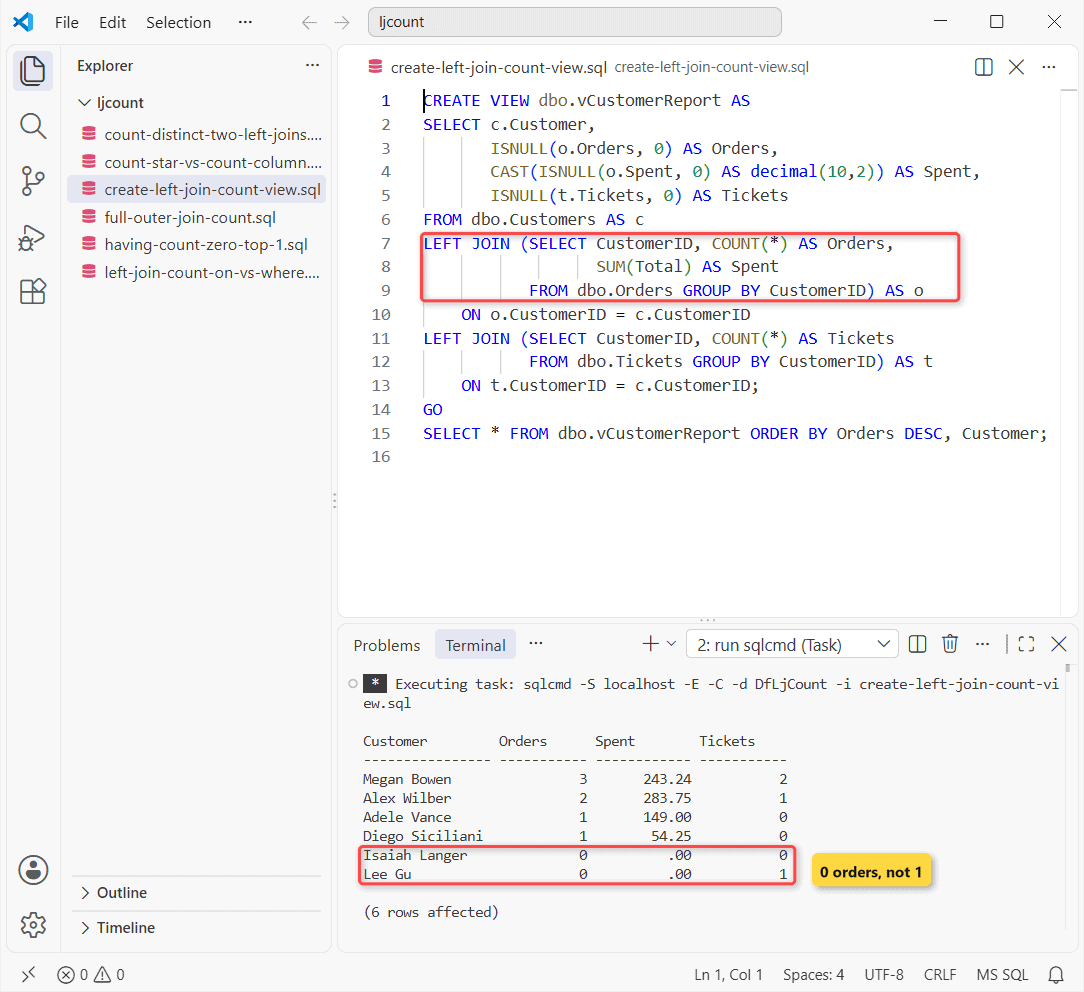
An unmatched customer still gets one joined row, padded with NULLs. COUNT(*) counts it; COUNT(o.OrderID) skips the NULL and returns 0. Here’s the report we’re building:
Before You Start: Sample Customers, Orders and Tickets
Test setup: SQL Server 17.0.1000.7 (2025) Developer edition, sqlcmd in VS Code. Isaiah and Lee have no orders; order 1008 has no customer:
CREATE TABLE dbo.Customers (
    CustomerID int PRIMARY KEY,
    Customer   nvarchar(16) NOT NULL,
    State      char(2) NOT NULL);
CREATE TABLE dbo.Orders (
    OrderID    int PRIMARY KEY,
    CustomerID int NULL,
    OrderDate  date NOT NULL,
    Total      decimal(10,2) NOT NULL,
    Status     varchar(7) NOT NULL);
CREATE TABLE dbo.Tickets (
    TicketID int PRIMARY KEY, CustomerID int NOT NULL);

INSERT INTO dbo.Customers VALUES
(1, N'Megan Bowen', 'WA'), (2, N'Alex Wilber', 'TX'),
(3, N'Adele Vance', 'CA'), (4, N'Diego Siciliani', 'NY'),
(5, N'Lee Gu', 'IL'),      (6, N'Isaiah Langer', 'FL');

INSERT INTO dbo.Orders VALUES
(1001, 1, '2025-11-14',  39.99, 'Shipped'),
(1002, 1, '2026-03-02', 149.00, 'Shipped'),
(1003, 1, '2026-09-17',  54.25, 'Pending'),
(1004, 2, '2026-01-08', 229.50, 'Shipped'),
(1005, 2, '2026-10-12',  54.25, 'Pending'),
(1006, 3, '2025-12-21', 149.00, 'Shipped'),
(1007, 4, '2026-10-02',  54.25, 'Pending'),
(1008, NULL, '2026-10-20', 19.99, 'Shipped');

INSERT INTO dbo.Tickets VALUES (1, 1), (2, 1), (3, 2), (4, 5);
Step 1: Count Orders per Customer With LEFT JOIN and COUNT(column)
SET NOCOUNT ON;
SELECT c.Customer,
       COUNT(*)         AS CountStar,
       COUNT(o.OrderID) AS Orders
FROM dbo.Customers AS c
LEFT JOIN dbo.Orders AS o
    ON o.CustomerID = c.CustomerID
GROUP BY c.CustomerID, c.Customer
ORDER BY Orders DESC, c.Customer;
Output:
Customer         CountStar   Orders
---------------- ----------- -----------
Megan Bowen                3           3
Alex Wilber                2           2
Adele Vance                1           1
Diego Siciliani            1           1
Isaiah Langer              1           0
Lee Gu                     1           0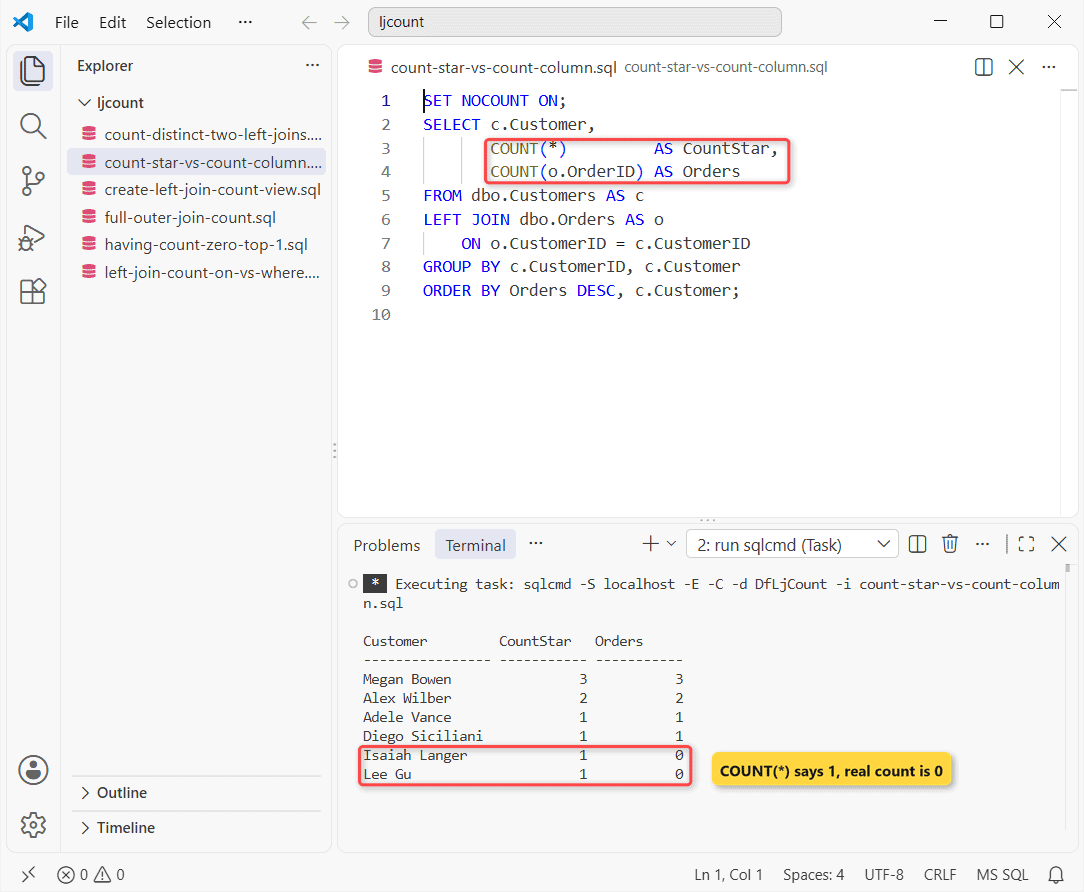
What this tells me: the LEFT JOIN in SQL Server kept all six customers, but COUNT(*) can’t tell an order from a NULL-padded row.
Checkpoint: you should see six rows totaling 7 orders; guest order 1008 isn’t counted.
Step 2: Count Only Shipped Orders (Filter in ON, Not WHERE)
SET NOCOUNT ON;
SELECT c.Customer, COUNT(o.OrderID) AS Shipped
FROM dbo.Customers AS c
LEFT JOIN dbo.Orders AS o
    ON o.CustomerID = c.CustomerID AND o.Status = 'Shipped'
GROUP BY c.Customer ORDER BY c.Customer;

SELECT c.Customer, COUNT(o.OrderID) AS Shipped
FROM dbo.Customers AS c
LEFT JOIN dbo.Orders AS o ON o.CustomerID = c.CustomerID
WHERE o.Status = 'Shipped'
GROUP BY c.Customer ORDER BY c.Customer;
Output:
Customer         Shipped
---------------- -----------
Adele Vance                1
Alex Wilber                1
Diego Siciliani            0
Isaiah Langer              0
Lee Gu                     0
Megan Bowen                2
Customer         Shipped
---------------- -----------
Adele Vance                1
Alex Wilber                1
Megan Bowen                2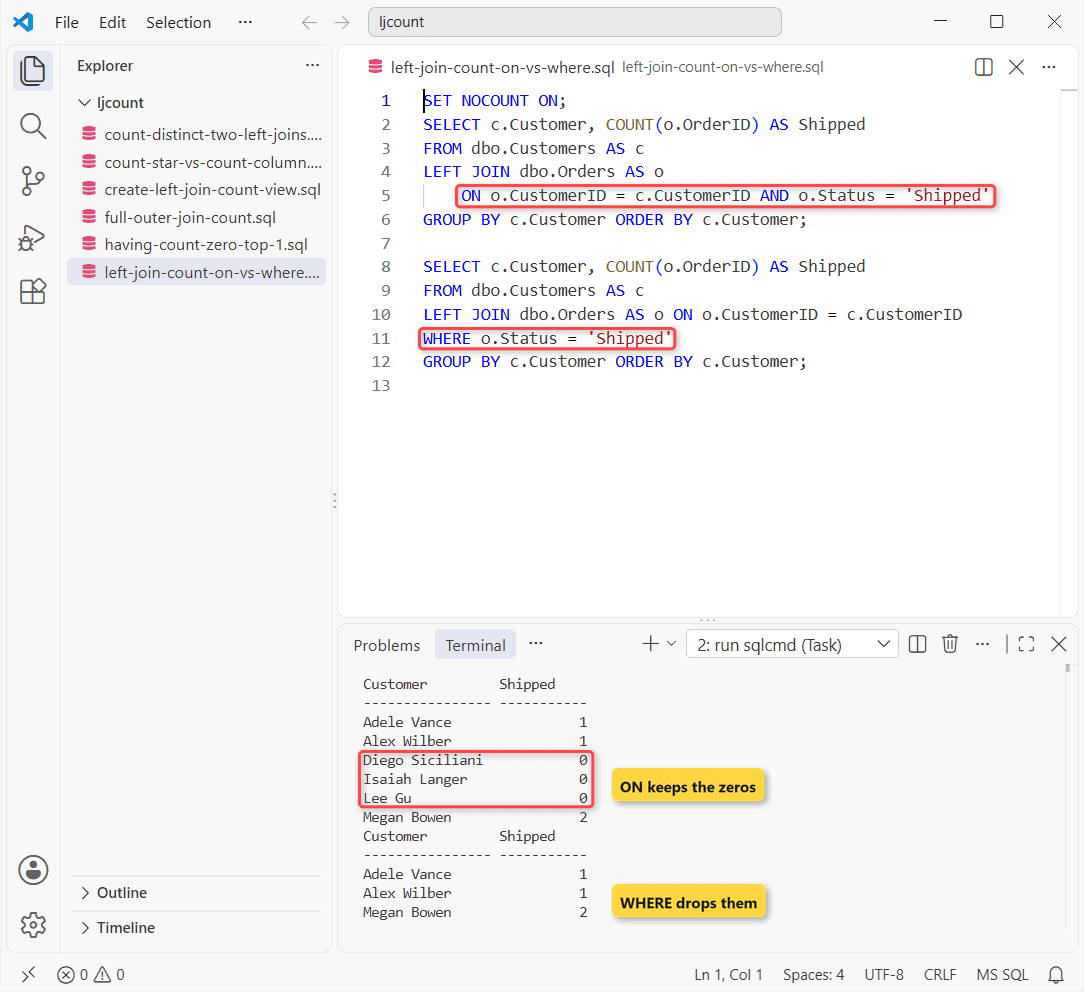
Important: the WHERE version became an inner join: o.Status is NULL on unmatched rows, so Diego, Isaiah and Lee drop out. In ON it only picks which orders match (LEFT OUTER JOIN with a WHERE clause).
Checkpoint: you see six rows with three zeros, then three.
Step 3: Add a Second LEFT JOIN Without Inflating the Count
Tickets doubled Megan’s orders:
SET NOCOUNT ON;
SELECT c.Customer,
       COUNT(o.OrderID)          AS OrdersWrong,
       COUNT(DISTINCT o.OrderID) AS Orders,
       COUNT(DISTINCT t.TicketID) AS Tickets
FROM dbo.Customers AS c
LEFT JOIN dbo.Orders  AS o ON o.CustomerID = c.CustomerID
LEFT JOIN dbo.Tickets AS t ON t.CustomerID = c.CustomerID
GROUP BY c.CustomerID, c.Customer
ORDER BY c.Customer;
Output:
Customer         OrdersWrong Orders      Tickets
---------------- ----------- ----------- -----------
Adele Vance                1           1           0
Alex Wilber                2           2           1
Diego Siciliani            1           1           0
Isaiah Langer              0           0           0
Lee Gu                     0           0           1
Megan Bowen                6           3           2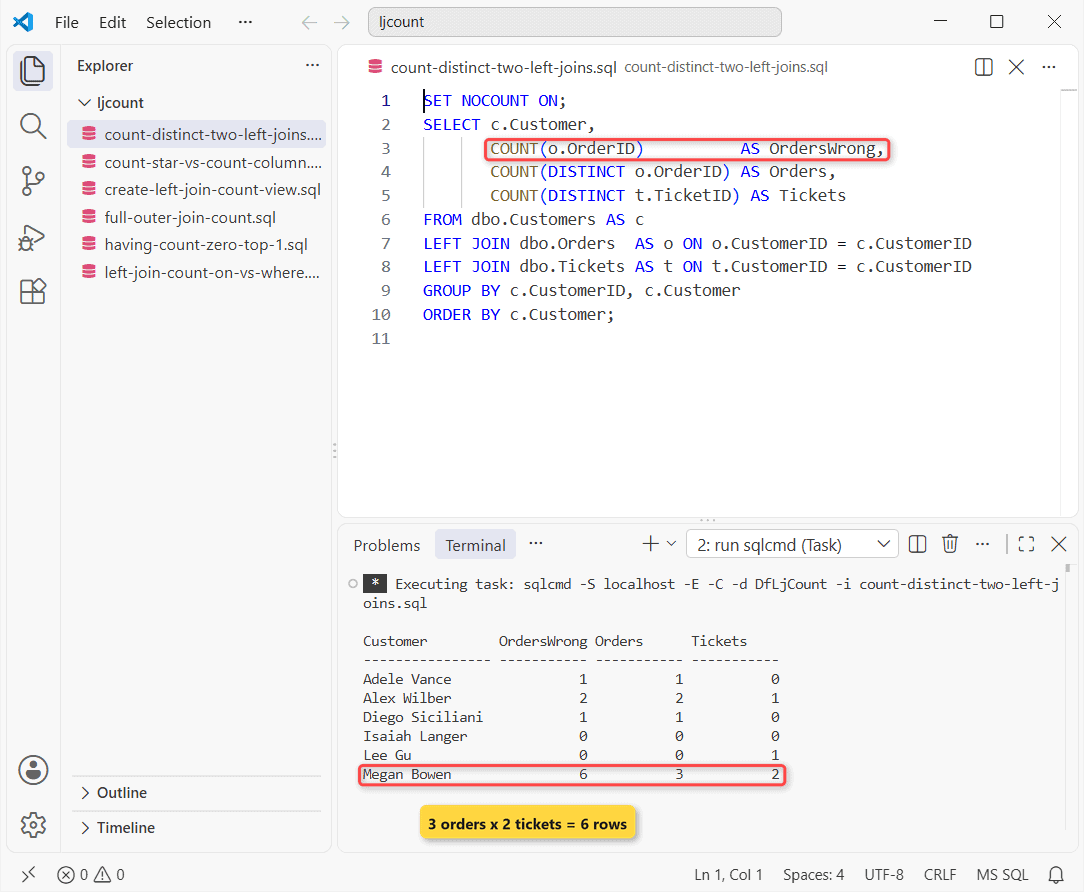
You get six rows: three orders times two tickets. COUNT(DISTINCT ...) repairs counts, like DISTINCT in a JOIN, but not a SUM. So I pre-aggregated.
Step 4: Save the LEFT JOIN Count Report as a View
Each derived table returns one row per customer, so nothing multiplies. ISNULL turns gaps into 0, and a view in SQL Server queries like a table:
CREATE VIEW dbo.vCustomerReport AS
SELECT c.Customer,
       ISNULL(o.Orders, 0) AS Orders,
       CAST(ISNULL(o.Spent, 0) AS decimal(10,2)) AS Spent,
       ISNULL(t.Tickets, 0) AS Tickets
FROM dbo.Customers AS c
LEFT JOIN (SELECT CustomerID, COUNT(*) AS Orders,
                  SUM(Total) AS Spent
           FROM dbo.Orders GROUP BY CustomerID) AS o
    ON o.CustomerID = c.CustomerID
LEFT JOIN (SELECT CustomerID, COUNT(*) AS Tickets
           FROM dbo.Tickets GROUP BY CustomerID) AS t
    ON t.CustomerID = c.CustomerID;
GO
SELECT * FROM dbo.vCustomerReport ORDER BY Orders DESC, Customer;
Output:
Customer         Orders      Spent        Tickets
---------------- ----------- ------------ -----------
Megan Bowen                3       243.24           2
Alex Wilber                2       283.75           1
Adele Vance                1       149.00           0
Diego Siciliani            1        54.25           0
Isaiah Langer              0          .00           0
Lee Gu                     0          .00           1

(6 rows affected)
Test the LEFT JOIN Count Report: HAVING COUNT = 0 and TOP 1
SET NOCOUNT ON;
SELECT c.Customer AS NoOrders
FROM dbo.Customers AS c
LEFT JOIN dbo.Orders AS o ON o.CustomerID = c.CustomerID
GROUP BY c.Customer
HAVING COUNT(o.OrderID) = 0;

SELECT TOP (1) WITH TIES c.Customer, COUNT(o.OrderID) AS Orders
FROM dbo.Customers AS c
LEFT JOIN dbo.Orders AS o ON o.CustomerID = c.CustomerID
GROUP BY c.Customer
ORDER BY Orders DESC;
Output:
NoOrders
----------------
Isaiah Langer
Lee Gu
Customer         Orders
---------------- -----------
Megan Bowen                3
HAVING COUNT(o.OrderID) = 0 gives you parents with no children. WITH TIES keeps every customer tied for first; plain TOP (1) picks one arbitrarily (see INNER JOIN with TOP 1).
How Do You Count LEFT JOIN Rows by Year?
A YEAR() filter in WHERE drops your zeros again. Count conditionally: COUNT(CASE WHEN YEAR(o.OrderDate) = 2026 THEN o.OrderID END). My run gave Megan 2, Alex 2, Diego 1 and 0 for the other three.
Variation: RIGHT JOIN and FULL OUTER JOIN With COUNT
RIGHT JOIN is LEFT JOIN with the tables swapped. FULL OUTER JOIN keeps both sides, so the guest order appears:
SET NOCOUNT ON;
SELECT ISNULL(c.Customer, N'(guest)') AS Customer,
       COUNT(o.OrderID) AS Orders
FROM dbo.Customers AS c
FULL OUTER JOIN dbo.Orders AS o
    ON o.CustomerID = c.CustomerID
GROUP BY c.Customer
ORDER BY Orders DESC, Customer;
Output:
Customer         Orders
---------------- -----------
Megan Bowen                3
Alex Wilber                2
(guest)                    1
Adele Vance                1
Diego Siciliani            1
Isaiah Langer              0
Lee Gu                     0
The FULL OUTER JOIN with a WHERE clause has the same ON-vs-WHERE trap.
My Takeaways and Fixes for LEFT JOIN Counts
- Count the right table’s key, never *, when zeros matter.
- Put right-table filters in ON.
- Two child tables? Pre-aggregate each one before joining.
Tested on six customers; fan-out gets expensive at scale.
Where to Take It Next
For matched rows only, see COUNT with a join and GROUP BY. PostgreSQL runs these queries unchanged (joins in PostgreSQL).
More join reading:
Frequently Asked Questions
Does COUNT(*) count rows that are all NULL?
Yes, per the COUNT reference. COUNT returns int; past 2,147,483,647 use COUNT_BIG.
Can I index a view that uses LEFT JOIN with COUNT?
No. Creating its clustered index failed with Error 10113: indexed views allow no OUTER joins.
Can I count per customer without GROUP BY?
Yes: COUNT(o.OrderID) OVER (PARTITION BY c.CustomerID) adds the count to every joined row.

Shivam Dogra is a cloud database developer and Team Lead at TSInfo Technologies, where he has worked since June 2021. He writes the SQL Server and Oracle tutorials on DatabaseFAQs.com, covering queries, joins, stored procedures, triggers and permissions. Shivam holds a Master of Computer Applications (MCA) from Chandigarh University.