
Say you need every order over $100 from a US store’s October 2026 sales. The PostgreSQL WHERE clause keeps only rows where the condition is true:
SELECT order_id, status, amount
FROM orders
WHERE amount > 100;
I tested this in psql on PostgreSQL 18.6, Windows 64-bit:
 order_id | status  | amount
----------+---------+--------
      101 | Shipped | 249.00
      103 | Shipped | 132.00
      105 | Pending | 412.30
(3 rows)Sample tables for the WHERE examples
Six customers, seven orders. Guest order 106 (NULL customer_id), the NULL coupons and order 105 (10/31/2026, 6:45 PM) each trigger a gotcha:
CREATE TABLE customers (
  customer_id int PRIMARY KEY,
  name        varchar(20),
  state       char(2)
);
INSERT INTO customers VALUES
 (1,'Megan Bowen','TX'), (2,'Alex Wilber','CA'), (3,'Adele Vance','WA'),
 (4,'Lee Gu','TX'), (5,'Lidia Holloway','NY'), (6,'Diego Siciliani','CO');
CREATE TABLE orders (
  order_id    int PRIMARY KEY,
  customer_id int,
  status      varchar(10),
  amount      numeric(10,2),
  ordered_at  timestamp(0),
  coupon      varchar(8)
);
INSERT INTO orders VALUES
 (101,1,'Shipped',249.00,'2026-10-01 09:15',NULL),
 (102,2,'Pending',89.50,'2026-10-03 14:02','FALL10'),
 (103,3,'Shipped',132.00,'2026-10-15 10:20',NULL),
 (104,4,'Canceled',15.75,'2026-10-07 11:05',NULL),
 (105,1,'Pending',412.30,'2026-10-31 18:45','VIP5'),
 (106,NULL,'Shipped',64.99,'2026-10-18 13:45',NULL),
 (107,5,'Shipped',89.50,'2026-11-01 00:00','FALL10');
New to this? Start with creating a table in PostgreSQL.
WHERE with multiple conditions: AND, OR and parentheses
AND binds tighter than OR. Same orders table, two versions of “Shipped or Pending, over $200”:
SELECT order_id, status FROM orders
WHERE status = 'Shipped' OR status = 'Pending'
  AND amount > 200;

SELECT order_id, status FROM orders
WHERE (status = 'Shipped' OR status = 'Pending')
  AND amount > 200;
Output:
 order_id | status
----------+---------
      101 | Shipped
      103 | Shipped
      105 | Pending
      106 | Shipped
      107 | Shipped
(5 rows)

 order_id | status
----------+---------
      101 | Shipped
      105 | Pending
(2 rows)
How does this work?
Without parentheses PostgreSQL reads Shipped OR (Pending AND > 200), so cheap shipped orders sneak in.
Important: parenthesize any OR that sits next to an AND. For branching inside SELECT, use a CASE expression.
PostgreSQL WHERE IN with a list of values
IN replaces a chain of ORs, and the docs call it equivalent to = ANY:
SELECT 'IN' AS test, count(*) FROM orders
WHERE status IN ('Pending', 'Canceled')
UNION ALL
SELECT '= ANY', count(*) FROM orders
WHERE status = ANY (ARRAY['Pending', 'Canceled'])
UNION ALL
SELECT 'NOT IN', count(*) FROM orders
WHERE status NOT IN ('Pending', 'Canceled');
Output:
  test  | count
--------+-------
 IN     |     3
 = ANY  |     3
 NOT IN |     4
(3 rows)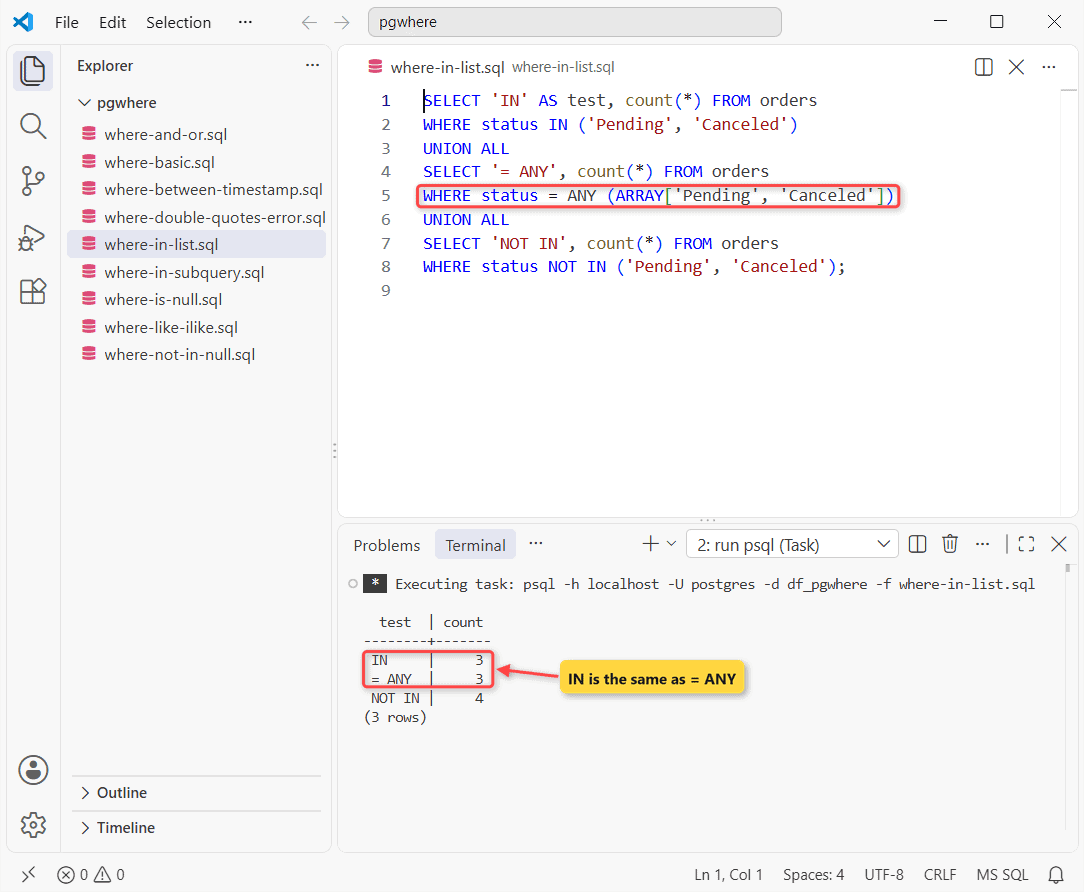
Values with apostrophes need escaped single quotes.
WHERE IN with a subquery
Same orders, filtered by a customers subquery: Texas buyers only.
SELECT order_id, customer_id FROM orders
WHERE customer_id IN (
  SELECT customer_id FROM customers WHERE state = 'TX');
Output:
 order_id | customer_id
----------+-------------
      101 |           1
      104 |           4
      105 |           1
(3 rows)
The inner SELECT returns IDs 1 and 4; the outer WHERE keeps their orders. A JOIN works too.
Why does WHERE NOT IN return no rows?
I hit this in my demo: Diego never ordered, yet NOT IN finds nobody:
SELECT name FROM customers
WHERE customer_id NOT IN (SELECT customer_id FROM orders);

SELECT name FROM customers c
WHERE NOT EXISTS (
  SELECT 1 FROM orders o WHERE o.customer_id = c.customer_id);
Output:
 name
------
(0 rows)

      name
-----------------
 Diego Siciliani
(1 row)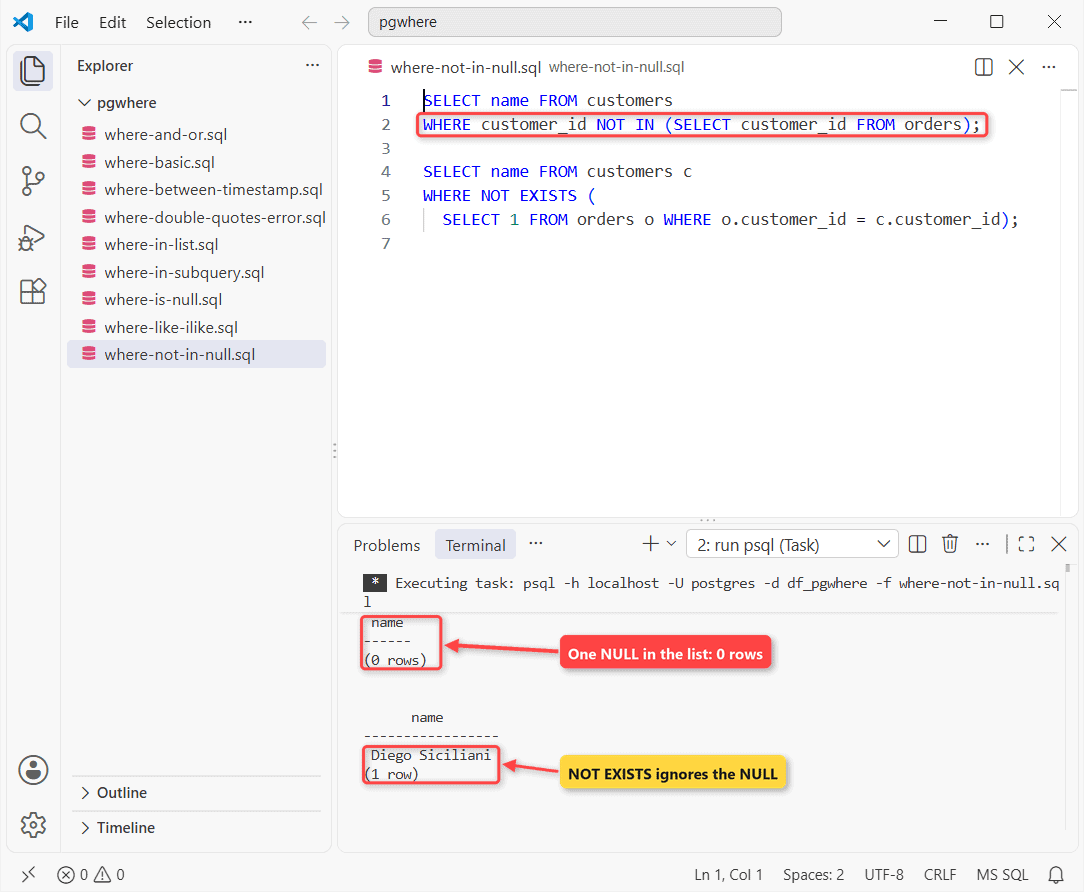
How does this work?
Order 106 puts a NULL in the list. 6 <> NULL is unknown, so NOT IN rejects every row. NOT EXISTS doesn’t care.
LIKE vs ILIKE in a WHERE clause
LIKE is case-sensitive; ILIKE, a PostgreSQL extension, isn’t:
SELECT name FROM customers WHERE name LIKE 'a%';

SELECT name FROM customers WHERE name ILIKE 'a%';
Output:
 name
------
(0 rows)

    name
-------------
 Alex Wilber
 Adele Vance
(2 rows)
WHERE column IS NULL, not = NULL
Same orders, four with no coupon:
SELECT '= NULL' AS test, count(*) FROM orders
WHERE coupon = NULL
UNION ALL
SELECT 'IS NULL', count(*) FROM orders
WHERE coupon IS NULL
UNION ALL
SELECT 'IS DISTINCT FROM', count(*) FROM orders
WHERE coupon IS DISTINCT FROM 'FALL10';
Output:
       test       | count
------------------+-------
 = NULL           |     0
 IS NULL          |     4
 IS DISTINCT FROM |     5
(3 rows)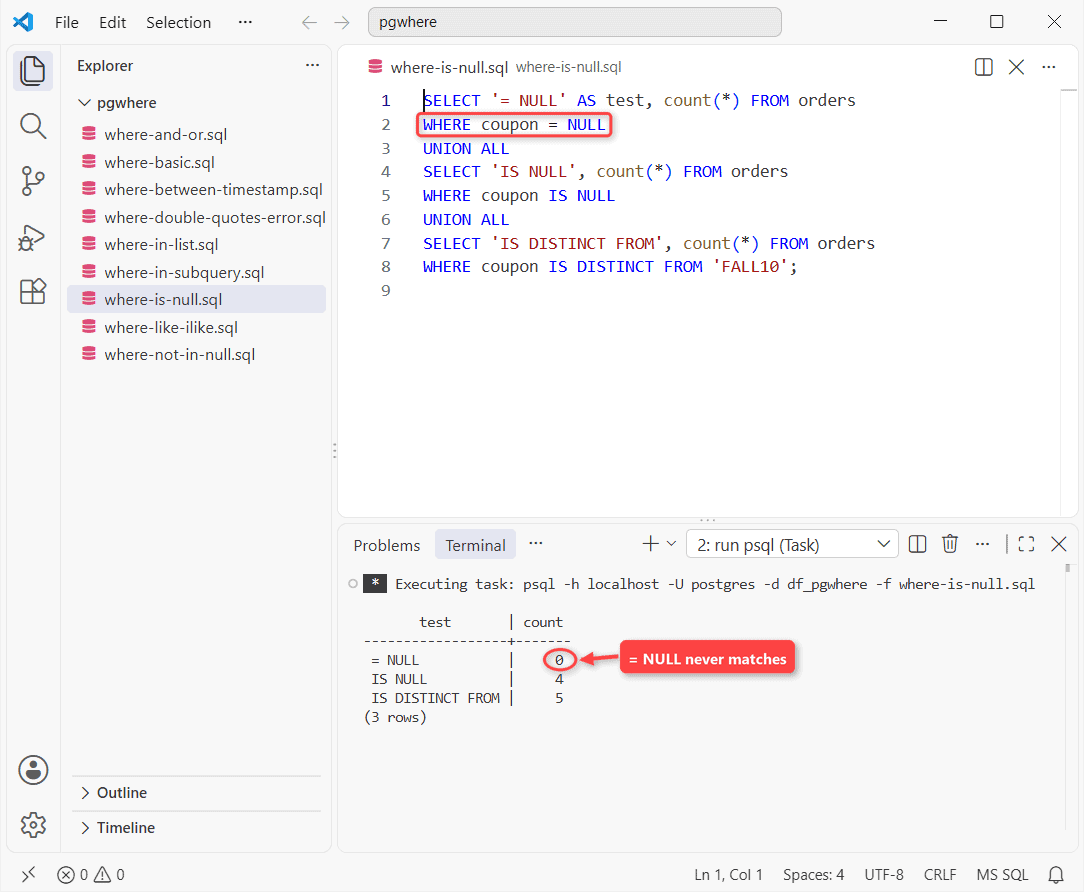
= NULL is never true. IS DISTINCT FROM 'FALL10' returns 5 because it counts NULL coupons; plain <> would return 1.
BETWEEN on a timestamp: both ends are inclusive
On a timestamp, ‘2026-10-31’ means midnight, so order 105 at 6:45 PM falls out. Here both WHERE tests run as columns:
SELECT order_id, ordered_at,
  ordered_at BETWEEN '2026-10-01' AND '2026-10-31'
    AS between_test,
  ordered_at >= '2026-10-01' AND ordered_at < '2026-11-01'
    AS half_open
FROM orders
WHERE amount > 200;
Output:
 order_id |     ordered_at      | between_test | half_open
----------+---------------------+--------------+-----------
      101 | 2026-10-01 09:15:00 | t            | t
      105 | 2026-10-31 18:45:00 | f            | t
(2 rows)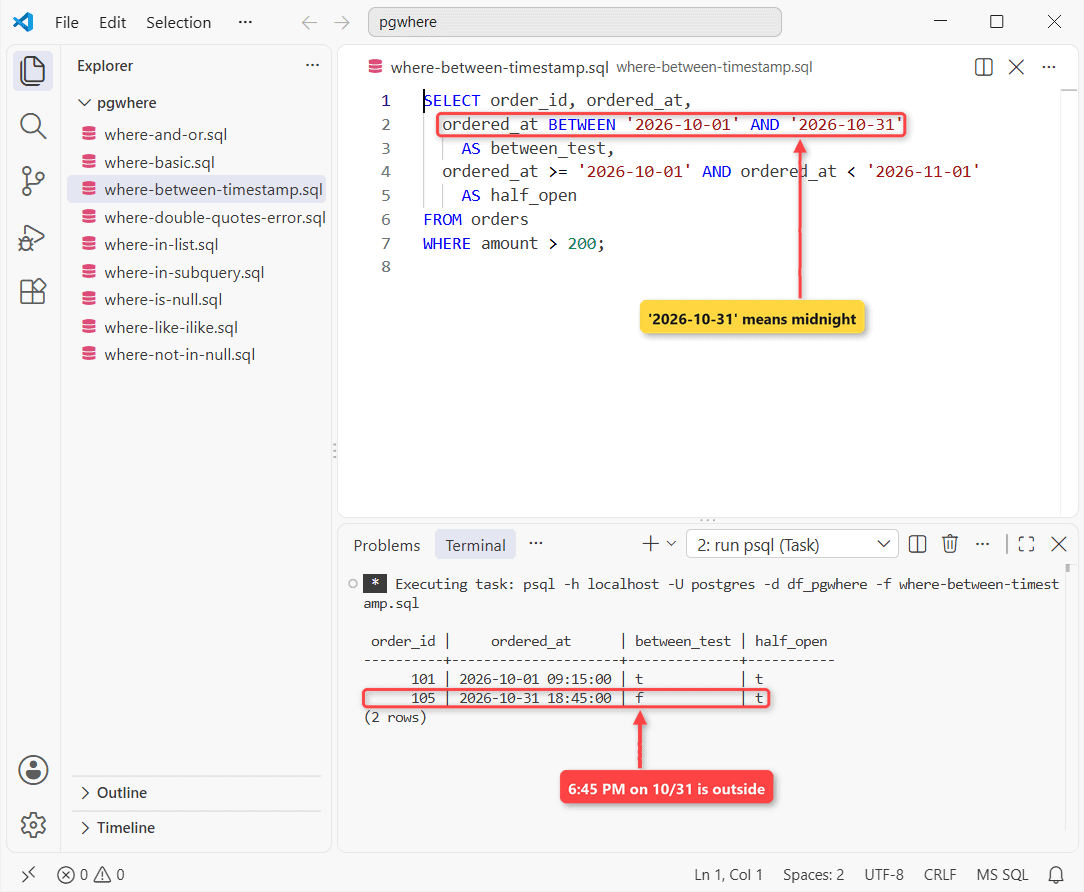
Use >= start AND < next day; the PostgreSQL date range guide covers months.
Single vs double quotes: column does not exist (42703)
Double quotes mark a column name, not a string:
\set VERBOSITY verbose
SELECT count(*) FROM orders WHERE status = "Shipped";
Output and error:
psql:where-double-quotes-error.sql:2: ERROR:  42703: column "Shipped" does not exist
LINE 1: SELECT count(*) FROM orders WHERE status = "Shipped";
                                                   ^
LOCATION:  errorMissingColumn, parse_relation.c:3859
You need single quotes for strings.
Things to Keep in Mind
- WHERE can’t see SELECT aliases or aggregates; filter groups with HAVING.
- The same WHERE drives UPDATE and DELETE. Test it as a SELECT first.
lower(col)skips a plain index.
Next step: sort the result with ORDER BY. Also useful:
Frequently Asked Questions
Is there a limit on how many values IN can hold?
No fixed limit, but huge lists slow parsing. Pass an array to = ANY($1) instead.
Can I make = NULL work like IS NULL?
transform_null_equals does that rewrite, but the docs say fix the SQL (comparison operators).
Is NOT IN the same as ALL?
Yes. Both return NULL, not true, when the list holds a NULL (subquery expressions).

Kumar Saurabh is a freelance software engineer who builds web and mobile apps with Next.js, React, Flutter and Python. From 2021 to 2024, Saurabh worked as an IT analyst and developer at TSInfo Technologies, writing technical articles on SQL and PostgreSQL. Saurabh writes the PostgreSQL, MySQL, MariaDB and MongoDB tutorials on DatabaseFAQs.com and holds a Master of Computer Applications (MCA) from Chandigarh University.