Trigger For Delete in SQL Server

Example of for trigger delete sql server

We will learn how to use the Trigger For Delete SQL Server statement here. To help you understand the idea better, we will also discuss and learn various examples. Trigger for Delete SQL Server In this SQL Server section, we will learn and understand how to use the SQL Server FOR trigger, which is used with the DELETE statement of … Read more >>

Oracle Long raw Datatype

Using long raw datatype in sql developer tool

In this Oracle tutorial, we will learn about the Long raw data in the Oracle database. Also, we will illustrate how to use it to create long raw columns for a table in Oracle. Oracle Long raw Datatype Let us start with the introduction, and then move to the other section. Introduction In Oracle, binary big … Read more >>

How To connect To Oracle Database Using Python

Connect to Oracle Database using Python Pyodbc

In this oracle tutorial, we will learn multiple approaches to connect to Oracle database using Python. How To connect To Oracle Database Using Python Read How to create a database in Oracle 19c Approach-1 Using Python Pyodbc In this section, we will learn to connect to Oracle database using Python pyodbc. Source Code: In this … Read more >>

Connect Excel to Oracle Database

Connect Excel to Oracle Database

In this oracle tutorial, we will learn how to connect excel to oracle database. Connect Excel to Oracle Database In this section, we will learn how to connect Excel to Oracle Database without ODBC. Approach-1: Without ODBC To connect Excel to Oracle Database, follow the below steps. 1. Open Microsoft Excel and click on the … Read more >>

Oracle Change Database Name

change database in oracle error ora-01127

In this Oracle tutorial, we will learn how to change the name of the database in Oracle Database 21c, 19c, and 12c. Oracle change database name Oracle Database name can be changed using the NID tool, which is installed by default when installing Oracle Database 21c on the Windows operating system. Please note that the database … Read more >>

Oracle rowid Datatype

Using raw datatype in oracle 21c

In this Oracle tutorial, we will learn about the rowid datatype in the oracle database. Also, we will illustrate how to use it to create rowid columns for a table in oracle. Oracle rowid Datatype The ROWID datatype in Oracle 21c stores the unique address of a row in a database table. It is 18 characters long … Read more >>

Exception Handling in SQL Server

Exception handling in SQL Server

I recently worked on creating the table and encountered an error. Errors are common in a development project. Exception handling or Error handling is an essential concept in software development. Like other programming languages, namely C, C++, and Java, SQL Server also provides exception handling. TRY and CATCH can handle errors in SQL Server. This … Read more >>

View Line Numbers in SQL Server Management Studio

View line numbers in SQL Server Management Studio

While creating the function, I encountered an error and was unable to find the exact line. After several checks, I found the line number in SQL Server Management Studio. In this SQL Server tutorial, we will learn how to view line numbers in SQL Server Management Studio. View Line Numbers in SQL Server Management Studio SQL … Read more >>

SQL Server stored procedure return value

SQL Server stored procedure return value 0

In this SQL Server tutorial, we will discuss how to return value from stored procedure and how to return some specific values from a stored procedure, etc. SQL Server stored procedure return value In SQL Server 2019, there are mainly 3 methods for returning some values from a SQL stored procedure to its caller. All three methods are … Read more >>

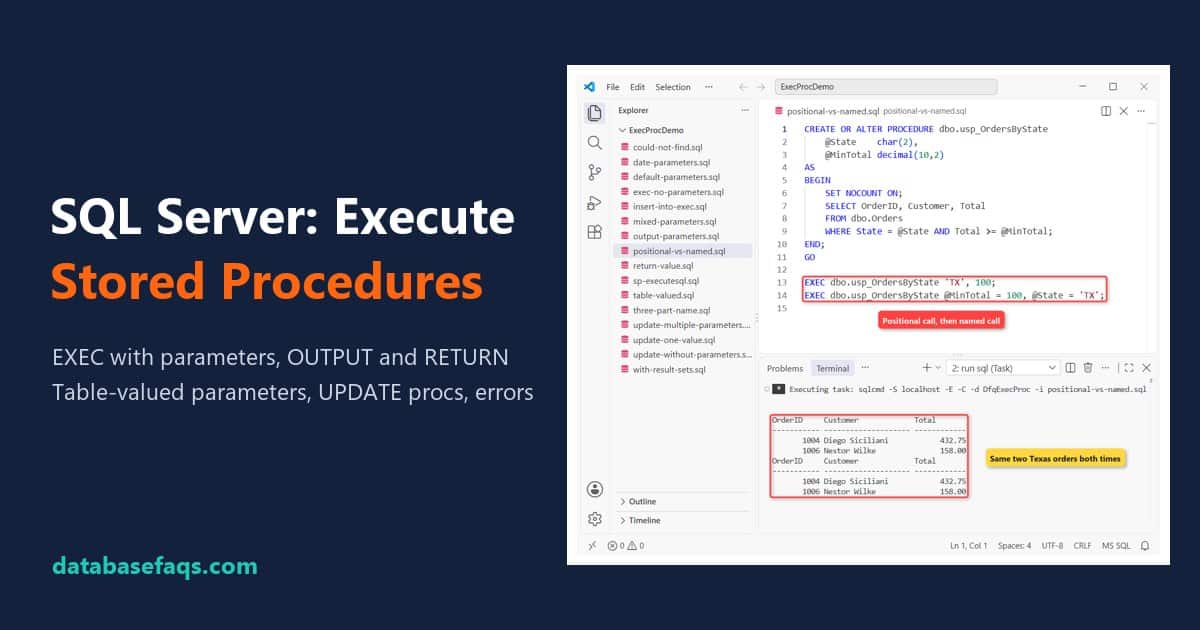
How to Execute a Stored Procedure in SQL Server (EXEC With Parameters)

Execute stored procedure in SQL Server with EXEC, positional and named parameters

Many guides still execute stored procedures in SQL Server with bare values and no schema, like EXEC usp_OrdersByState ‘TX’, 100. It works, right up until someone adds a parameter. The safer way is EXEC plus the schema-qualified name and named parameters, so every value lands where you meant it: EXEC dbo.usp_OrdersByState @State = ‘TX’, @MinTotal … Read more >>